Types of lifting slings: fabric, wire rope, chain and shackles
Fabric slings come round or flat, and locally either one is called «واير قماش», literally "cloth wire". Then come wire rope slings, chains, and the steel parts joining them to the hook. The operator picks by the load's weight, shape and surface. What you might notice from a safe distance:
| Type | What it is | What you might notice |
|---|---|---|
| Round sling | Polyester yarns that carry the load, inside a protective fabric cover | Any cut in the cover can mean damaged yarns underneath |
| Flat webbing sling | A woven strap, usually with an eye at each end | The strap's edges, the eyes and the stitching |
| Wire rope sling | Twisted steel wires with an eye or ring at each end | Broken wires sticking out, kinks, obvious rust |
| Chain sling | Steel links with a master link and hooks | A capacity tag, and links free of nicks and cracks |
| Shackle | A U-shaped steel piece closed by a pin | A pin that stays put, a body that isn't bent |
| Crane hook | The crane's hook, with a latch across its opening | A latch that closes, an opening that hasn't spread |
Lifting sling colour code: what each colour means
Polyester slings made to the European standards EN 1492-1 (flat webbing slings) and EN 1492-2 (round slings) are coloured by their working load limit (WLL) in a direct, straight lift, which Dolezych says is the figure that sets the colour. Slings of other materials, or made to other standards, may use colour differently. This is the list as published by Dolezych, a German sling manufacturer, and CERTEX, a Danish lifting gear supplier, both citing those standards:
| Colour | Working load limit |
|---|---|
| Violet | 1 tonne |
| Green | 2 tonnes |
| Yellow | 3 tonnes |
| Grey | 4 tonnes |
| Red | 5 tonnes |
| Brown | 6 tonnes |
| Blue | 8 tonnes |
| Orange | 10 tonnes and above; Dolezych gives 10 to 40 tonnes |
The label decides, not the colour
Colour is a quick read from a distance; the label sewn onto the sling is the final word. CERTEX calls it the most reliable guide to capacity, and Dolezych says it always carries the working load limit. Colour alone falls short because:
- Not every sling is made to the European standard, and some makers add their own markings on top, such as the black stripes CERTEX describes on slings it sells, which aren't part of EN 1492.
- Sun, oil and dirt change how a colour looks, and dirt can hide damage.
- The colour code is for polyester; the label's own colour shows the material, blue for polyester and, Dolezych notes, white for UHMW-PE round slings.
- CERTEX says a sling whose label is lost or unreadable comes out of service, as does a chain missing its tag.
Does a 5 tonne sling lift a 5 tonne load?
Not necessarily. The label gives the working load limit for one way of using the sling, and Dolezych points out that the limit changes with the lifting method. How it is attached, how many slings there are and how they share the load all change what one sling can take, and that can be less than its number. That's the operator's calculation, not one to attempt yourself.
The crane has its own limit at the reach it's working to, covered in the guide to choosing crane capacity. Sling, shackle, hook and crane each have a limit, and the lift happens only when all of them can take the load. Bought slings of your own? Send the operator a photo of the label beforehand; the operator decides whether they suit the lift.
Warning signs worth raising with the operator
You're not an inspector, and nobody expects you to check slings. But if you see any of these, mention it calmly before the load goes up. Most come from the rejection criteria CERTEX publishes for textile slings and steel lifting parts:
| What you notice | What it can mean |
|---|---|
| A cut in the strap or a round sling's cover, open stitching, a cut eye | Load-bearing yarns may be cut |
| Heavy wear in one spot, or frayed edges | A weak point, often from a sharp edge |
| An odd glaze, or fibres melted together | Heat or friction damage |
| A surface that flakes or rubs off by hand | Chemical damage |
| A torn, unreadable or missing label | Nobody knows what it carries, so it isn't used |
| A knot tied in the sling, or a sling twisted on itself | Worth asking about before the lift |
| A hook latch that's broken or won't close, or a spread opening | The sling could slip off |
| Steel with a crack, bend, twist or obvious rust, a nicked chain, a loose pin | The part may be damaged or overloaded |
- Say it and leave the decision to the operator. CERTEX says any doubt is enough to take a sling out of service until a competent person examines it.
- Don't touch a sling under tension, and don't fix or tape it; CERTEX warns against repairing a sling yourself.
- Never say "just this once, it's light". A damaged sling doesn't know the load is light.
- If a sling or chain once took a hard jolt, say so. CERTEX says a part shock-loaded that way comes out of service even with no visible damage.
Sharp edges cut lifting slings
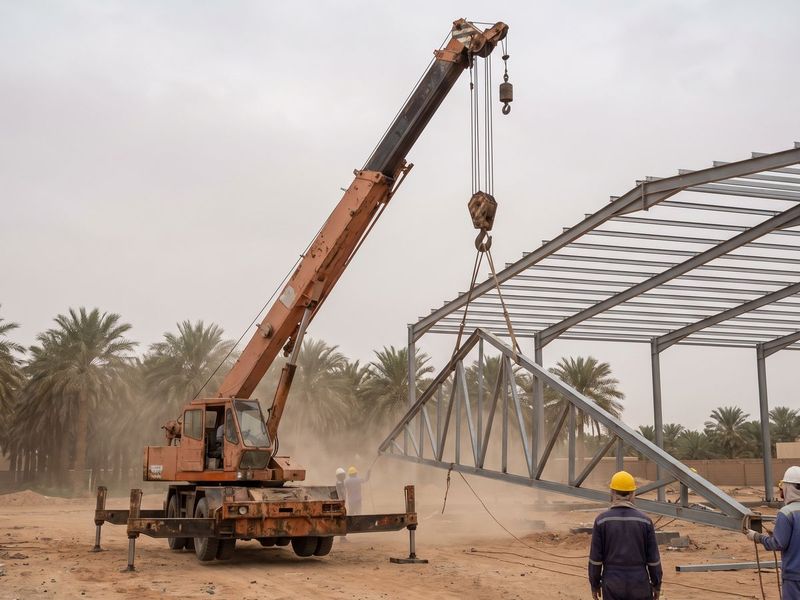
CERTEX warns that a fabric sling dragged over a sharp edge while it's taking the load can be cut through or badly weakened. On Qassim jobs the edges are everywhere: beams and trusses when erecting a hangar, steel tank corners, machine bases, precast concrete.
- Photograph the load from every side, corners and steel edges in view.
- Say if the surface is freshly painted, scratches easily, or has pipes or handles sticking out.
- Edge protection is the operator's call. Cardboard or a rag you put down isn't protection.
Why rigging is the operator's call
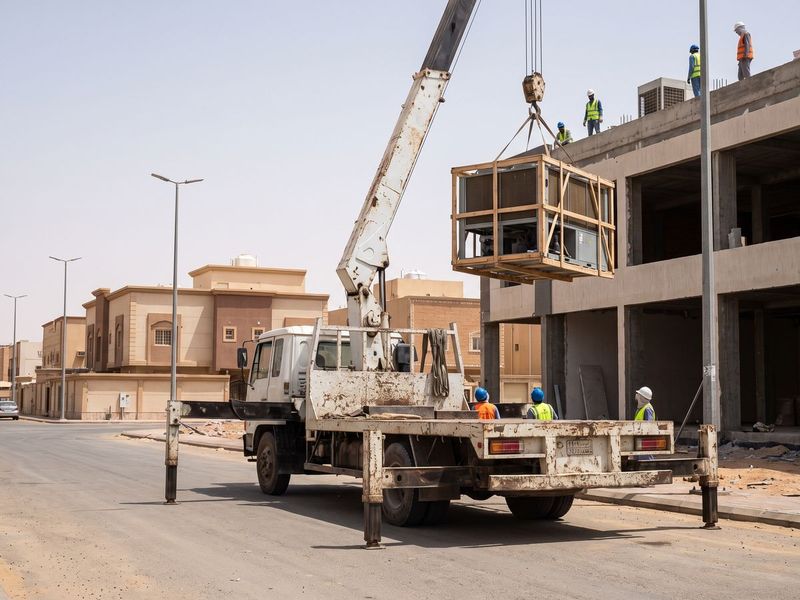
The operator knows the crane and its load chart and can see the load and the slings, so the operator chooses the sling type, how many, how they're attached and where the load is held. Every one of our cranes comes with its operator, and rigging done before the crane arrives usually gets redone. Your part is the right information:
- The real weight, from the plate, the invoice or the maker, not a guess.
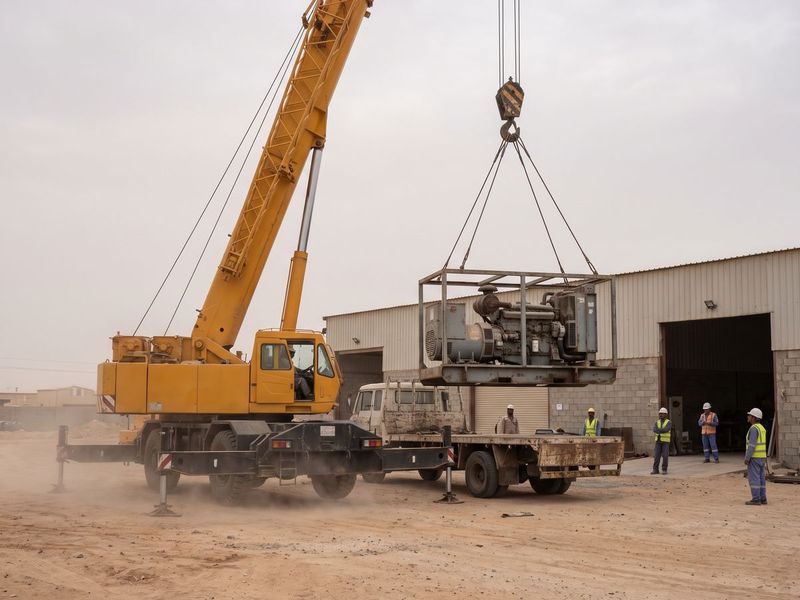
- The maker's lifting points for a machine or generator; the guide to moving a generator shows why not just any ring will do.
- The centre of gravity if the spec sheet gives it, since a load heavier at one end tilts in the air.
- Anything inside that could shift, such as water left in a tank or an unlatched door.
Who inspects lifting slings, and how often?
Not the load owner. CERTEX says slings are looked over before and during every use, examined by a competent person at regular intervals, and the records kept. That's a European supplier's guidance, and the interval differs from one set of rules to another; the rule for your site is a question for whoever runs it.
If your site has a safety officer, ask what they require from any crane coming in, and tell us in your first message if equipment papers or an entry permit are needed, so it's settled before the crane sets off, not at the gate.
Nobody under a suspended load
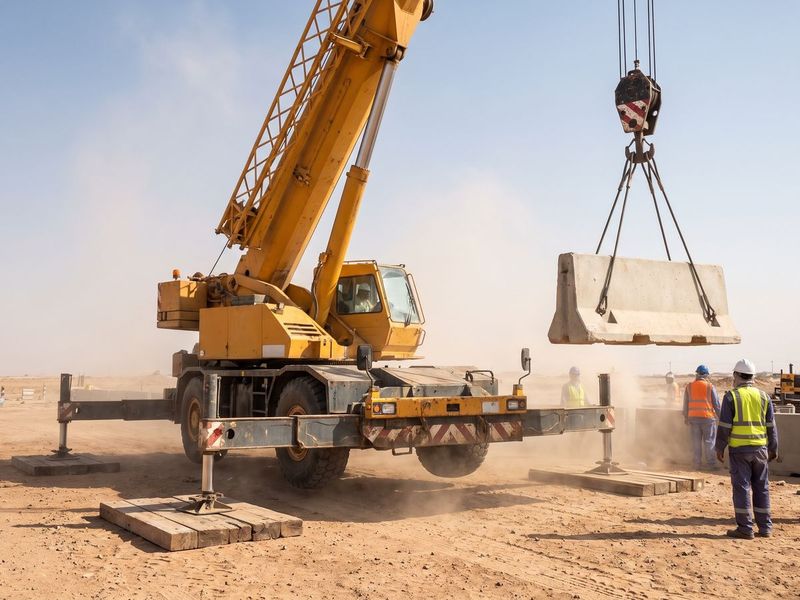
Even when everything is sound, a load in the air can swing, turn or tilt, a sling can fail and a load can slip. So nobody stands under or beside it, and nobody rides the load or the hook, ever. We keep people clear of the suspended load on every job, but you know who's on your site:
- One person from your side talks to the operator; everyone else stays back.
- Workers, children and cars stay out of the lift area and the load's path.
- Don't touch the load or the sling while it's in the air, and keep hands out from between sling and load.
- If the operator says stop, or the wind picks up, don't rush them. Who does what on the day is in the guide to preparing a site for a crane.
Lifting slings and your crane booking: what to send on WhatsApp
Our cranes go out with their operators from our yard in Al Ihtifalat, Ar Rass, to every city in Qassim, with a clear price before we start, by the hour, the day or the job. More on crane hire with an operator.
A message like this is enough: “Hi, I've got a machine to lift into a warehouse. Photos attached: the plate with its weight, every side, and the lifting points on the base. It has sharp steel edges, and here's the label of a fabric sling I bought. Location link below.”
Send us, in one message:
- What the load is, and its weight from the plate, invoice or maker.
- Photos from every side, with corners and sharp edges in view.
- A photo of the lifting points, if it has rings or a steel base.
- A photo of the label or tag of any slings or chains you want used.
- A map link, and a photo of where the crane can stand and where the load goes.
- Any papers or entry permit your site requires for equipment.