Moving a generator, step by step
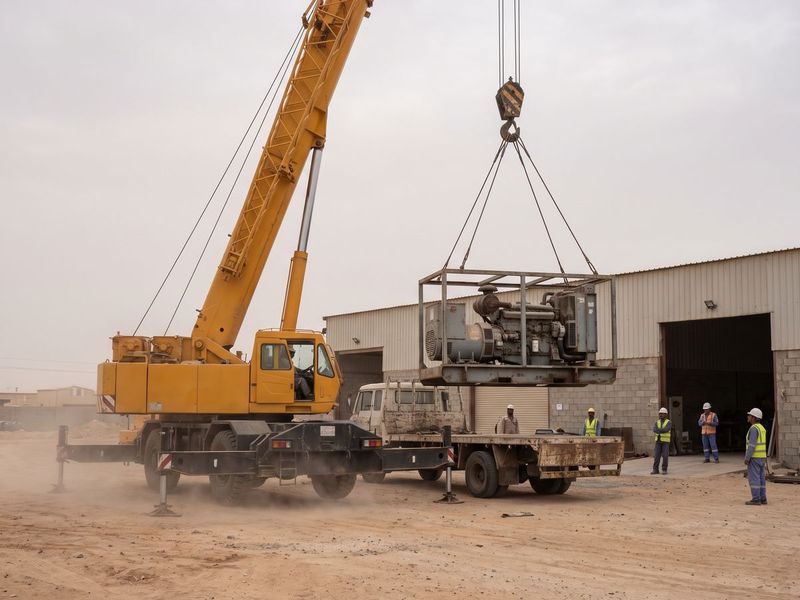
This is what happens from your first message until the set runs in its new place. We lift, move and set down; disconnecting it before and reconnecting it after are the technician's job:
| Step | What happens | Who |
|---|---|---|
| Before the day | You send the weight, size, photos and both locations, which decide the crane, trailer and price | You |
| The day before | Cables disconnected at the transfer panel and the set, then the battery, fuel line and exhaust; the base tank emptied | Electrician and supplier's technician |
| At the new site | Base finished, level and set hard | Engineer and contractor |
| The lift | Rigged from the maker's lifting points | Crane operator, who decides the rigging |
| Loading | Chained down on the lowbed | Lowbed driver |
| Set-down | Lowered straight onto the base, facing the way you marked | Crane operator |
| Afterwards | Bolted down; power, fuel and exhaust reconnected; started and tested | Electrician and supplier's technician |
Before the lift: power, diesel and the battery
Everything that ties the set to the site is disconnected before the crane arrives, by a technician who knows the set, not by the crane operator and not by you:
- Power: cables disconnected at the transfer panel and at the set. A cable dragged during the lift gets damaged and becomes a hazard.
- The battery: disconnected the way the manual says, because a standby set can start itself on a signal from the transfer switch or a remote start switch.
- Diesel: Kohler's installation manual for its industrial generator sets (TP-5700) says a base tank is lifted only when empty of fuel or any other liquid, whether it goes up alone or with the set. Ask the supplier to empty it before the day; if your own set's manual allows otherwise, tell us in your first message how much will stay in, because diesel adds weight and shifts inside the tank.
- An outside fuel line and the exhaust: disconnected and capped, so nothing drips and nothing sticking out catches the slings.
- Before it moves: photograph any leak underneath, and lock the enclosure doors.
How much does a generator weigh, and where is the real figure?
The crane is sized from the set's weight and its distance from where the crane parks; the guide to choosing crane capacity explains why distance matters as much. The kVA or kW in the model name is output, not weight. Two sets with the same rating can weigh very differently: one open, the other enclosed with a diesel tank underneath.
Kohler's manual says the total weight and centre of gravity must be known before the rigging is chosen. They're on the spec sheet or the drawing; failing that, ask the dealer. This is what goes into the weight:
| Part | Counts? | Where to find it |
|---|---|---|
| Engine and alternator on the base frame | Yes, most of it | Nameplate, spec sheet or invoice |
| Sound-attenuated enclosure | If it lifts with the set | Spec sheet |
| Base diesel tank | Unless it is separated | Drawing, or the supplier |
| Diesel, oil and coolant | Yes, and often forgotten | Ask whether the listed weight is dry or filled |
- No figure anywhere? Send a photo of the whole nameplate, the model and the size, and we'll estimate it with you. The dealer's figure is still the one to trust.
Generator lifting points: why not the engine eyes?
Lifting eyes on top of the engine or alternator look like the obvious place to hook on. Kohler's manual says no: the eyes on the engine, the alternator and the top of the radiator can't carry the whole set. It lifts from the eyes on the base frame, all of them. The same manual adds these, each one the operator's call, not yours:
- The weight isn't balanced; the manual warns about this, so the centre of gravity comes from the spec sheet or drawing, not a guess.
- A spreader bar keeps the slings off the air cleaner and anything else sticking out.
- Nothing is hooked to the enclosure, unless it was built with a single top eye for lifting the whole set.
- If the set and its diesel tank are lifted together, it's rigged from all of the tank's eyes.
- Nobody stands under or beside the set while it hangs.
Crane, boom truck or lift: it depends where the generator sits
Which machine you need depends on where the generator is and where it's going. In Qassim many people say ونش for a mobile crane and also for a small boom truck, so describe the job rather than the machine:
| Where the set is | Usually | Watch for |
|---|---|---|
| In an open yard | A crane lifts it onto the lowbed | Firm parking close by, no cables overhead |
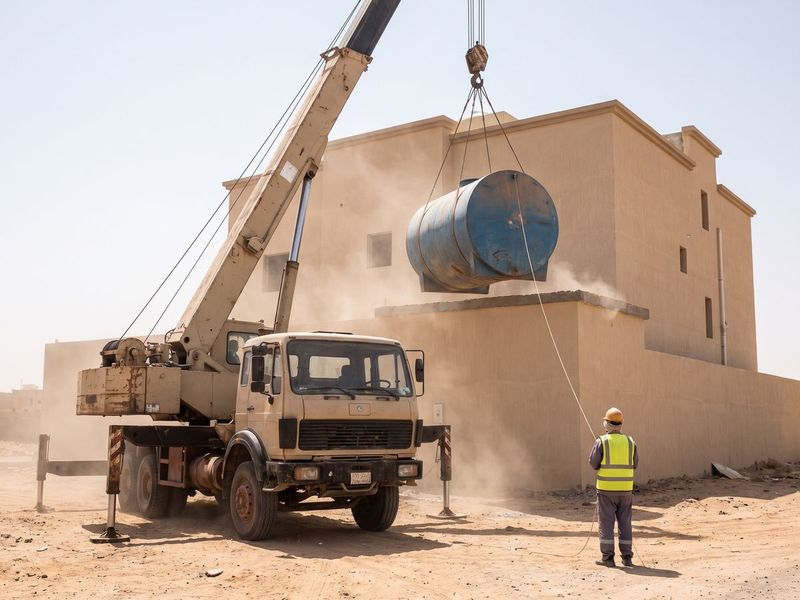
| Behind a wall or beside a building | A crane lifts it over | The further it is from the crane, the bigger the crane |
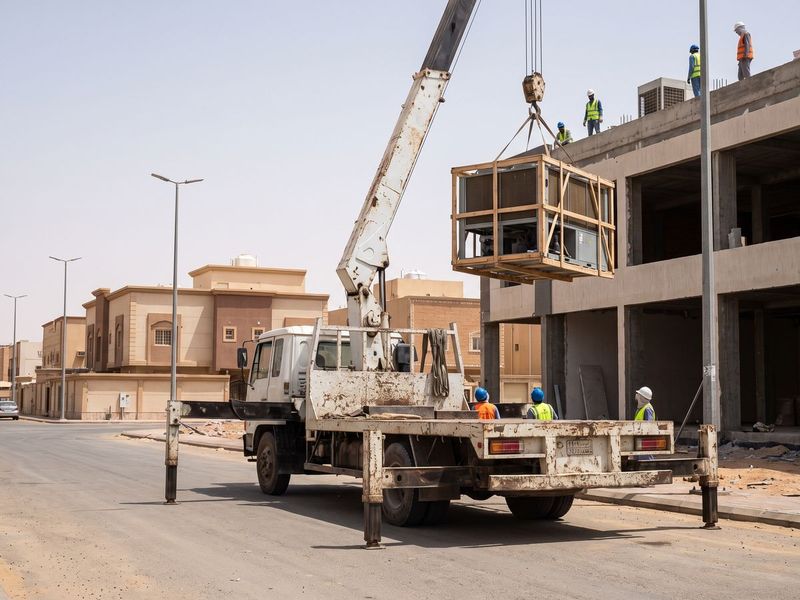
| On a roof | A crane takes it up or down | The roof is an engineer's question; see lifting tanks and generators onto roofs |
| Inside a roofed room | Out of a crane's reach | It comes out to open ground first, by a method a specialist decides |
| A small set on a pallet | A forklift may be enough | A level floor, and a weight within the lift's capacity |
- Never lift a generator with a loader, an excavator or your own slings. It can slide or tip, and anyone nearby is at risk.
Lowbed or flatbed for a generator?
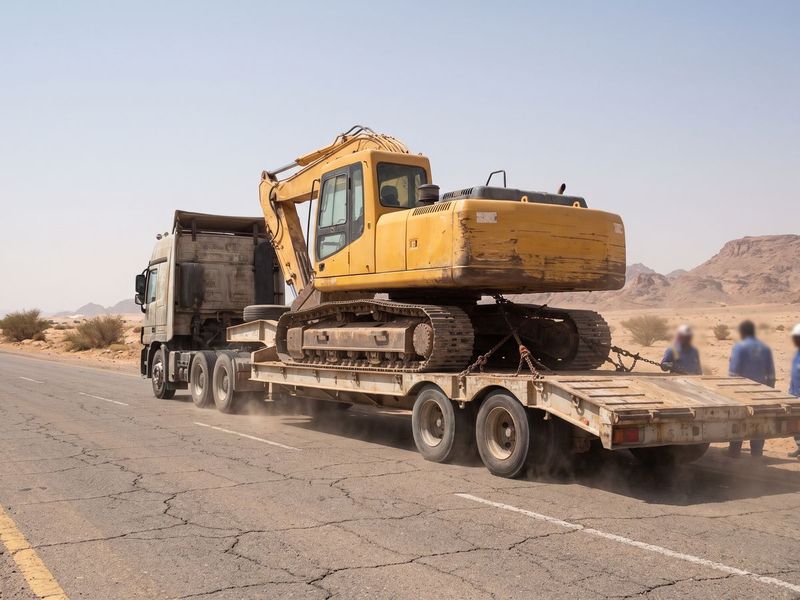
The trailer follows the set's size and weight, and the height that counts is the set plus the deck; the lowbed vs flatbed guide shows how to add it up. Kohler's manual recommends lowboy (lowbed) trailers for sets above 1000 kW.
It also warns that weight alone won't hold a set in place on the road: chains through the mounting holes in the base frame, tightened with binders, and no straps over an enclosure, which they damage. After the trip, the technician checks the radiator and fan before starting it.
If the load is wider, longer or heavier than usual, ask before you agree whether it needs a permit and who arranges it. We don't print legal limits here; ask the Transport General Authority.
Generator concrete pad: ready before moving day
The set should go straight from the crane onto its base, or you pay for a second lift or a crane standing idle. The pad is an engineer's design, not guesswork. The concrete must have fully set by moving day, not been poured the day before. Mark where the control panel and the exhaust will face, so nobody has to turn the set in the air.
Here is one example, from Kohler's manual; your own set's manual is the one to follow:
- A concrete pad with true right-angle corners, level at all four edges, and a top flat to within 3 mm.
- A pad weighing at least as much as the set and its accessories, so it may outweigh the generator.
- Ground underneath that carries both, checked by a technician or engineer.
- At least 457 mm between the set and any wall, for servicing.
- Cast-in or expansion anchor bolts, using every mounting hole in the base frame.
- A dry spot that doesn't flood, clear of dry grass, with flexible connections for the cables, fuel line and exhaust.
- On a roof, the building's engineer decides whether the structure can carry it.
At both sites: where the crane parks and the lowbed gets in
Generators tend to sit in a corner beside a building or behind a wall, among cables and canopies, so a set that was easy to install can be hard to move. Check both sites before you book; the checklist for preparing a site for a crane has the rest:
- Crane parking: firm, level ground close to the set. Mention fresh fill, a buried tank or a septic pit in your first message.
- Power lines: photograph any line over or near where the crane parks or the set sits, and mention it in your first message; don't judge the gap by eye. If any line is nearby, even off the lift path, contact the Saudi Electricity Company before the day. The operator has the final say, and if he says it isn't safe, the lift waits.
- The gate: room for the crane and the lowbed to get in and turn.
- A working site: a time with nobody under the lift path, and an agreed window when the site can do without its standby power.
What sets the price of moving a generator
Cranes are priced by the hour, the day or the job, and lowbeds by distance and load weight, and you get a clear price before we start. What changes it: the set's weight and distance from the crane, a crane at one end or both, the distance from Ar Rass and between the sites, and the access, ground and cables. A set still connected or a base not ready drags the job out, so finish the preparation first.
What to send on WhatsApp to move a generator
Our cranes and lowbeds go out with their operators and drivers from our yard in Al Ihtifalat, Ar Rass, to every city in Qassim, and to other cities by lowbed on request. Our machinery and generator moving service puts the crane and the lowbed in one booking.
A message like this is enough: “Hi, I have a diesel generator in an enclosure. Here are its nameplate and the lifting points on its base. It will be disconnected before the day and the new base is ready. I need it moved from this site to this one. What's the price?”
Send it all in one message:
- The make and model, and a photo of the whole nameplate.
- Its weight, whether that figure is dry or filled, and whether any diesel will stay in it.
- Length, width and height, and any enclosure or tank underneath.
- Photos of the lifting points and of every side.
- A map link for the pickup and another for the drop-off.
- Where the crane can park at each site, and whether the new base is ready.