Do you need a forklift, or is a crew enough?
A few dozen boxes on a pickup do not need a machine: your crew will finish before it gets there. A forklift earns its place once the work comes in pallets, such as full trucks, daily deliveries at a packing house, or stock going in and out of a cold store.
This is about the forklift that slides its forks under a pallet, not a crane or a winch truck. What it carries changes along the way:
| Stage | What the forklift carries | What decides the job |
|---|---|---|
| Empty packaging before the season | Bundles of cartons and crates, light but bulky | Size matters more than weight, and wind catches them |
| Farm to market or packing house | Harvest crates on pallets, or large plastic bins | The ground, starting before the heat, and soft fruit that cannot be stacked high |
| Receiving at the packing house | Pallets from the truck to the scale and the sorting line | Each farm's dates kept apart and labelled |
| In and out of the cold store | Pallets between the yard and their place inside | Door and rack height, wet floors, the type of engine |
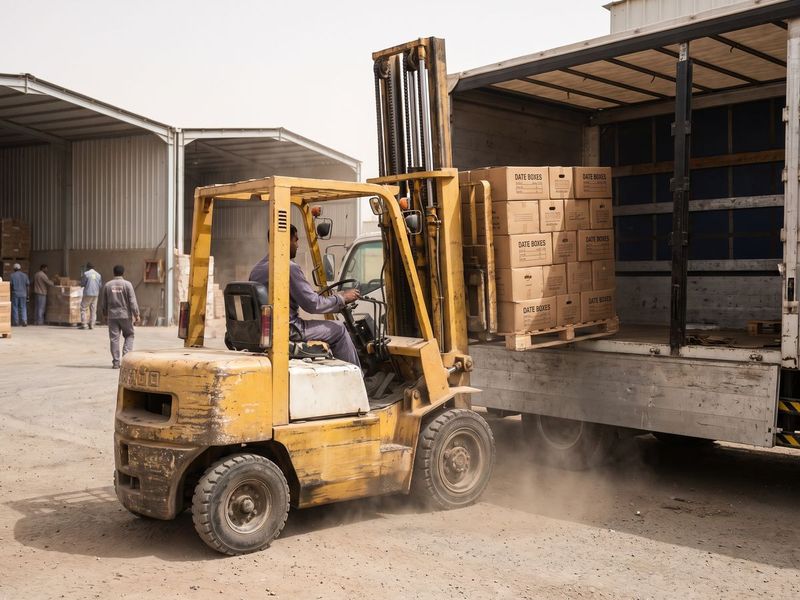
| Sending out orders | Wrapped cartons on pallets into a truck or a refrigerated container | Whether the truck opens at the side or only at the back |
Get the pallets ready before the forklift arrives
A forklift picks up pallets, not cartons one by one. If it arrives to loose boxes, the clock runs while your workers stack. Finish the stacking first, and check these:
- The pallet is sound: no broken boards or nails, and room for the forks underneath.
- Nothing hangs over the edge. The UN Food and Agriculture Organization (FAO) handbook on date palms describes a 50 by 30 cm box sized to fit a 120 by 100 cm pallet. Try your cartons on your pallets before you buy the season's supply.
- Heavy at the bottom, and little weight on soft fruit. Ask the carton maker how many layers they take.
- Similar heights, lower than the truck and cold store doors. A pallet that blocks the operator's view is slower: the American forklift rule (OSHA 1910.178) has them travel with the load trailing.
- Wrapped or strapped. The same rule allows only stable or safely arranged loads.
- Cartons kept dry. The FAO handbook warns that cardboard is sensitive to humidity, so keep it off wet floors and don't leave cold pallets sweating outside.
- Labels facing out: farm, variety and weight. The handbook says packing houses keep each grower's fruit apart by label, so a mixed pallet holds everyone up.
How heavy is a pallet of dates?
The first question you will hear is the weight of your heaviest load, and dates are hard to judge by eye, pressed dates most of all. Work it out as cartons on the pallet, times one full carton, plus the pallet itself.
As an example only, 60 cartons of 10 kg make 600 kg, plus the pallet. If you have a floor scale, weigh one finished pallet and photograph the reading. That beats any sum.
For large plastic harvest bins, the FAO handbook gives 200 to 450 kg of fruit each and says they suit dry dates. The bin's own weight is extra, and two stacked bins are twice the weight and a taller load. The plate on the forklift and its operator have the last word: see our forklift hire guide for what that plate means.
How long should you book it for?
The FAO handbook puts the date harvest in the northern hemisphere between the end of July and mid-November, depending on the area. Forklift work goes on after that: much of the crop is stored and sold through the year, and Ramadan orders leave the cold stores before the month begins. Book for your kind of work, not for the whole season:
| Your work | What to book | What wastes it |
|---|---|---|
| A farm loading a truck or two | By the hour, at a fixed time | A late truck, or crates not stacked yet |
| A big harvest day, or selling a large lot at once | By the day | All the trucks arriving together, then none |
| A packing house or store receiving every day | A longer period agreed for the season | Days with no deliveries that nobody counted |
| Ramadan orders out of the cold store | Set days, with orders grouped together | One order a day, spread over weeks |
- Time the first truck, from first pallet to closed doors. That is your real figure for the rest.
- Add time for changing trucks, prayers and lunch.
- Harvest shifts with the weather. Book a rough date early and say as soon as it moves.
Farm, market, cold store: what stops a forklift
The same machine works well in one place and stops in another. A photo before you book shows most of this:
| Place | What stops the work | What to do first |
|---|---|---|
| Between the palms, farm yard | Sand, irrigation ditches, low fronds, buried pipes | Load from the nearest firm ground to the gate, and bring the crates there by pickup |
| Sorting shade | A low roof and columns close together | Measure the lowest point and the gap between the columns |
| Market yard | Crowds and cars | Ask the market office when forklifts may come in, and keep a space clear of people during loading |
| Closed packing house or store | Diesel exhaust near open dates | Say in your first message that the work is indoors and there is food |
| Cold store | A low door, a wet floor, hard cold | Send the door height and temperature, and dry the floor |
| Fumigation room | Toxic gas | Nobody goes in, with or without a forklift, until the person in charge says it has been aired |
- The FAO handbook gives 18 degrees below zero as a common long-term storage temperature for several varieties, Medjool among them. Not every forklift is built for that, so ask first.
- The OSHA rule has drivers slow down on wet floors, so allow time for it.
- The handbook advises against storing fumigated and unfumigated dates together, so mark the pallets.
Does the truck open at the side, or only at the back?
This changes the whole timing, and many people leave it out. An open or curtain-sided truck loads from the side, if there is room on both sides. A box or refrigerated truck usually opens only at the back, so a forklift on the ground reaches the pallets by the door and no further. The rest needs a loading dock, or a hand pallet truck to pull pallets inside.
Check these before the first pallet. The first three are in the OSHA rule, which is American, not Saudi, but makes sense in any yard:
- The truck's brakes are set and its wheels chocked so it cannot roll.
- A trailer with no tractor attached may need supports to stop it tipping up.
- The truck floor is checked for breaks and weak spots before a forklift drives onto it.
- Nobody is on the truck bed while a pallet comes in, the driver included.
- On a refrigerated truck, ask the carrier where the stacking limit is, so cold air reaches every pallet.
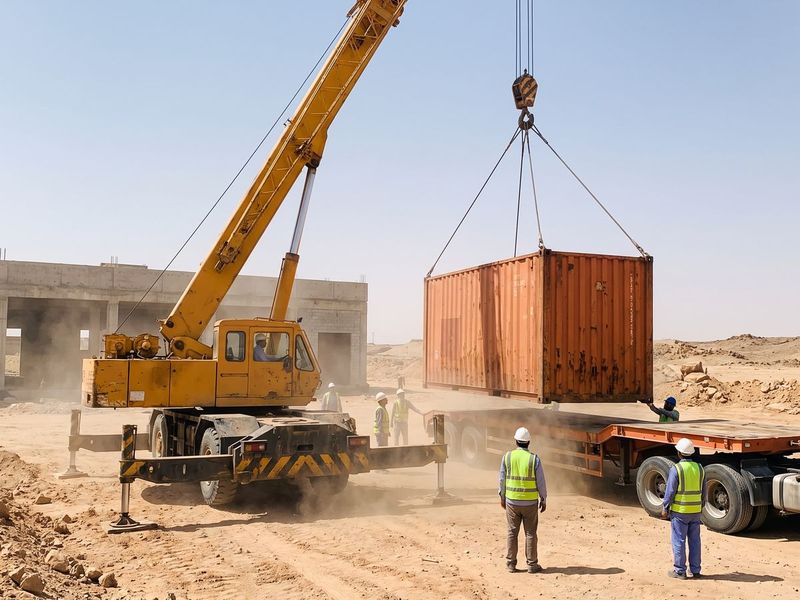
- If you want a container set on the ground to fill at your own pace, that is crane work, not forklift work.
Exhaust and oil around open dates
Nobody wants diesel fumes or a drop of oil near dates people will eat. Ask these before any forklift goes near uncovered dates:
- Is the work in a closed building? Ask about an electric machine, or how the place will be aired. OSHA limits the carbon monoxide that forklift work may produce.
- Is there a fuel leak? The same rule bars running the machine until it is fixed, and wants it inspected daily and free of excess oil and grease.
- Are the forks clean, and are the dates along the route covered?
Never lift a picker on the forks
The forklift is there, the palms are tall, and someone suggests raising a worker on the forks. No. Forks are for pallets: no guard rail, and nothing to hold a person if the machine leans on sand. The OSHA rule keeps unauthorised riders off, and nobody may stand or pass under the raised part.
Picking from the top has its own ladders and machines made to lift workers, and the FAO handbook mentions both. If your palms are near power lines, don't judge the distance by eye: talk to the Saudi Electricity Company first, and read working near power lines.
Plan the loading day
What a good loading day looks like, in order:
- The night before: pallets stacked, wrapped and weighed, in one place on firm ground.
- Early morning: the FAO handbook says dates picked at the khalal (bisr) stage should travel in the early hours, out of the heat, with refrigeration for a long trip.
- Before sunrise or at night: light the area. OSHA wants a light on the forklift too where general lighting is poor.
- Queue the trucks, with one person in charge who knows where each pallet goes. You say where, the operator decides how.
- Give the forklift its own route, clear of workers, children and empty pallets.
What sets the price of forklift hire for date season?
The size of machine your heaviest pallet calls for, how long you need it, and the distance from Ar Rass to you, whether that is a farm in Al Badaye or a store in Buraidah. Our lifting equipment comes with its operators, by the hour, the day or a longer period, at a better rate the longer it runs, and you get a clear price before we start.
What to send us on WhatsApp
A message like this is enough: "Hello, I have a date store in Unaizah and need a lift to load pallets onto a refrigerated trailer that opens at the back. The heaviest pallet is X kg and X high. The cold store door is X m high, concrete floor. X trucks a day for X days. Here is the location, with photos."
Send us these and we will tell you what suits the job from our lifting equipment, with a price and a time:
- Where the work is: farm, market, packing house or cold store.
- What the dates are in: cartons, crates or large bins, and whether they are on pallets.
- The weight and height of the heaviest pallet, with a photo.
- Whether the truck opens at the side or at the back.
- The lowest door or roof the machine passes under, and the highest rack it must reach.
- Sand or concrete, and whether the place is open, closed or chilled (and how cold).
- The rough date, trucks a day, and how many days.
- A map link, and photos of the entrance and the loading spot.