Why a crane near power lines is the deadliest mistake in lifting
The US National Institute for Occupational Safety and Health (NIOSH) wrote in a 1985 alert that it believes contact with power lines is the most common cause of deaths in mobile crane work. The alert is old and its figures are American, but electricity hasn't changed.
What stands out in the incidents NIOSH investigated is who died. Not one was in the crane's cab. All were on the ground: one guiding the load into place by hand, one hooking it on, one touching an outrigger while packing timber under it. The first person at risk is whoever is helping from below, and on your job that could be you, your worker or your son.
It doesn't have to touch: how electricity reaches the crane
The UK Health and Safety Executive (HSE) says it plainly in its guidance on overhead power lines: a wire doesn't need to be touched to kill or burn, because electricity can arc across a small gap to whatever is nearest. When it does, the whole crane becomes its path to earth: boom, rope, hook, load and outriggers.
- It isn't only the boom. The rope, the hook or the load can come close to a wire while the boom is well clear.
- A load swings with the wind and as the crane slews, and the tip of a long boom springs up a little when the load comes off it, a point made in the New South Wales Government's rigging guide in Australia.
- Lines are hard to see when you're tired or rushing or the light is dull, and transformers on a pole often sit lower than the wires. Both points are HSE's.
Six things people say on site, and why each is wrong
All six are said in good faith, and each brings the crane closer to the wire. The answers come from the official texts, not from us:
| What you hear | What's true |
|---|---|
| "The cable is coated, so it's insulated" | Most high-voltage wires are bare, and a covering can be damaged, says HSE. The US rule presumes every line uninsulated until its owner confirms otherwise. |
| "We won't touch it, we'll just go past it" | Electricity arcs without contact, and loads swing. The distance counts from the furthest point the boom, rope or load could reach, not from where the crane is parked. |
| "The power's off in the area today" | A power cut is not an isolation. A line can come back within seconds, so it is live until its owner confirms it is off. |
| "That's just a house cable, not high voltage" | A house supply kills too, and nobody can tell a line's voltage by looking. |
| "The crane's on rubber tyres, so it's insulated" | A crane lifts on steel outriggers planted on the ground, not on its tyres. If it goes live, so does the ground around it. |
| "I'll steady the load with a rope from a distance" | The US rule requires tag lines to be non-conductive, not whatever rope is to hand. Don't hold the load or its rope. Leave that to the crane crew. |
How close can a crane get to power lines?
We found no published Saudi figure for cranes that we could verify, so we won't make one up. The clearance for your line comes from its owner, because it depends on the voltage, and you can't read voltage off the look of a cable. To show the scale, here is what two official bodies outside the Kingdom require, taken from their own texts:
| Source | What it requires |
|---|---|
| US Occupational Safety and Health Administration (OSHA), crane rule 1926.1408 | With the crane at full reach, could any part of it, its rope or its load come within 20 feet (about 6.1 m) of the line? If so, work starts only in one of three ways: the owner confirms the line is off and earthed, or everything stays more than 20 feet away with measures to guarantee it, or the owner gives the voltage and the rule's table sets the distance. That covers lines up to 350 kV; the table reaches 45 feet (about 13.7 m) above 750 kV. |
| UK Health and Safety Executive (HSE), guidance note GS6 | Work within 10 m of a line, measured along the ground from below the nearest wire, needs its risks planned. Beside a line rather than under it, barriers go 6 m out from the nearest wire, further if a boom could reach in. |
- These are American and British rules for trained crews working to a plan. They are not Saudi law and not permission to lift.
- Both texts hold smaller distances that apply only once the owner has stated the voltage. That sum belongs to the owner and the crane crew, so we left them out.
- Don't measure by eye or with a tape: HSE says a wire's height is measured by a trained person with equipment that doesn't touch it.
- Under a line is stricter: the US rule allows no part of the crane or its load below one unless the owner confirms it is off and earthed, with limited exceptions.
Where the lines hide: house, street and farm
Before you book, go outside and look up. Check five places, not only where the crane will stand:
- Over and around the crane's spot, on every side the boom could swing to.
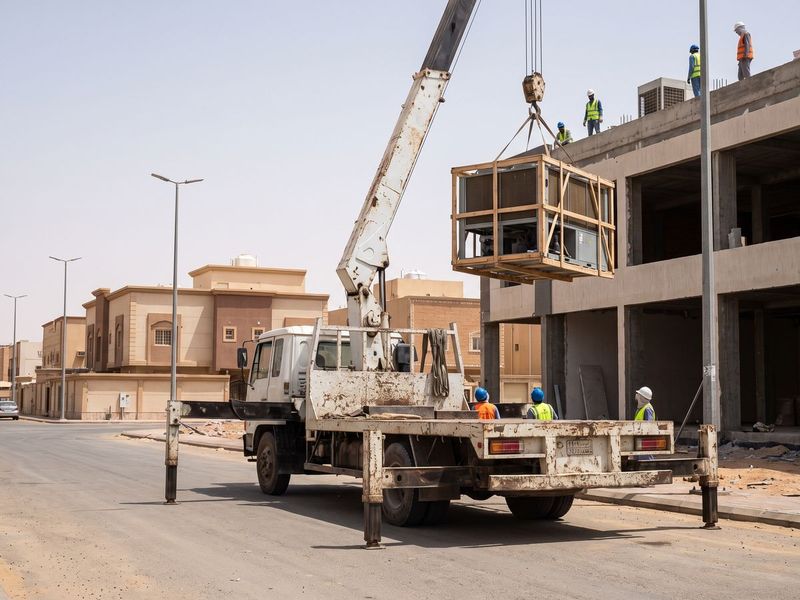
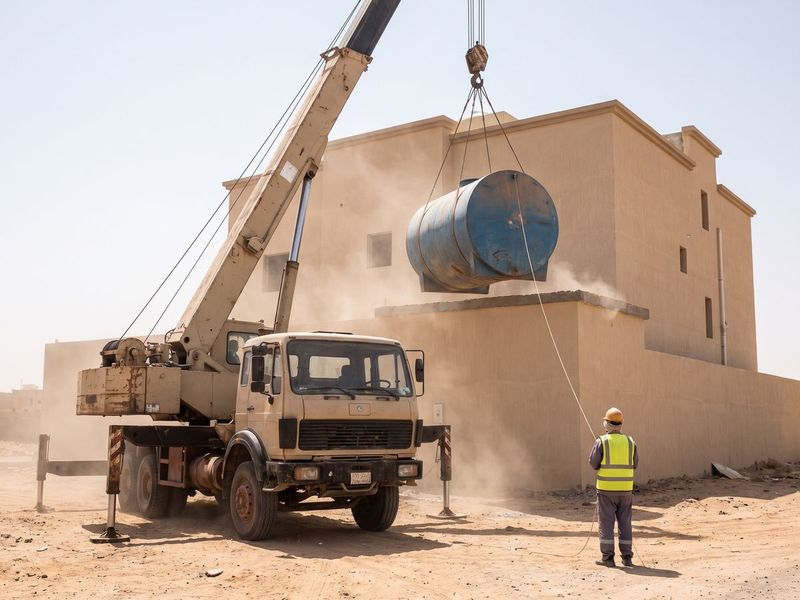
- Between the crane and where the load lands. The street line between the kerb and the house wall is easy to forget, and so is the service cable from the pole to the house. It matters most when a tank is going onto the roof.
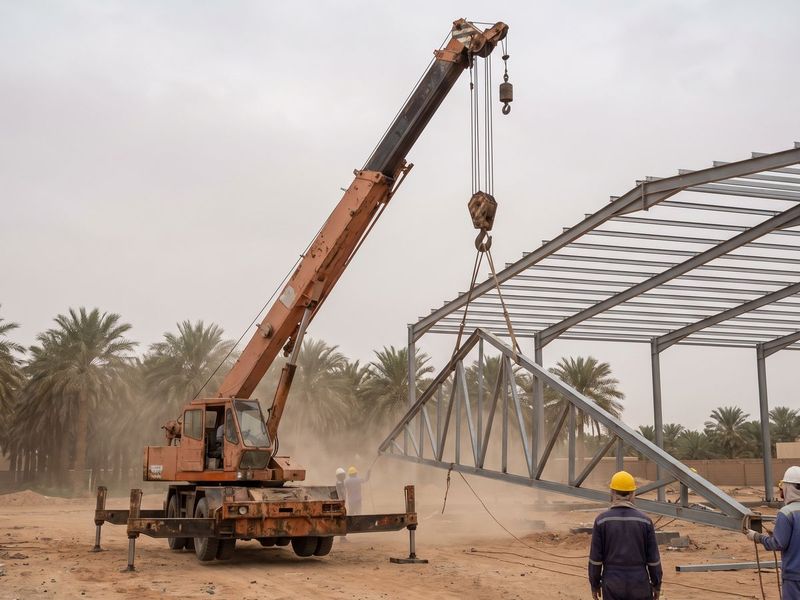
- Over the place where the load is waiting. Don't leave hangar steel or a tank under a power line, because that is where the hook will come down.
- On a farm: the line that follows the track, the line to the well pump or the hangar, and any pole carrying a transformer.
- Along the route in, for the crane and for a lowbed. A tall load counts at its overall height on the trailer, as the lowbed vs flatbed guide explains.
Before you book: what to ask the Saudi Electricity Company
Start days ahead, because the answer belongs to the line's owner, not to you or us. Photograph the line from two sides, with the pole, the crane's spot and the landing spot in the frame, and mention it in your first message to us or to any crane company, even if it looks far away. Don't fix a final date until the owner has answered.
We could not read the Saudi Electricity Company's procedure or charges for this, so ask them directly. HSE notes that in the UK a line owner needs time to consider such a request and may charge for it. Give them the map link and the date, and ask:
- What voltage is this line, and what clearance do you require between it and the crane and its load?
- Can you switch it off for the lift, or shield it? When, and how long does the request take?
- Is there a charge, and who applies: the site owner or the crane company?
- Who confirms on site that the line is off before we start?
The options in order, safest first
HSE ranks them like this, and "we'll be careful" is not on the list:
| Option | What it means | Who decides |
|---|---|---|
| Move the work away | Another setup spot or landing spot, so neither boom nor load can reach the line even if swung towards it | The operator, from your photos and then on site |
| Switch the line off | The owner switches it off, earths it and confirms that before the lift begins | The line's owner |
| Keep the owner's distance | A marked limit, and one person whose only job is to watch the gap and talk to the operator | The owner sets it; the crane crew keeps it |
| None of these is possible | No lift. In HSE's words: if it cannot be done safely, it should not be done at all | The operator, and nobody leans on them |
- If the crane has to stand further from the load because of a line, it may need to be a bigger crane, since a crane lifts less the further out the load is; see the crane capacity guide. Nearby lines also make a site harder, which affects the price, so mention them at the start.
On the day: your part
Where the crane stands, which way the boom goes and how the lift is done are the operator's decisions. Your part:
- Nobody from your side holds the load, its rope or the hook, or touches the crane or its outriggers during the lift.
- Keep people and cars away from the crane and the load's path, children above all.
- Don't ask the operator for "a bit closer" or "just this once". If they say it isn't safe, the lift waits.
- If you see the boom or the load nearing a wire, shout to the operator to stop, from where you are.
- Lift in daylight. HSE advises against working near lines in the dark, because floodlights dazzle more than they show the wire.
If the crane touches a line: what to do and who to call
These are the minutes when the person who runs to help gets hurt. The steps come from HSE's guidance and the US rule:
- Nobody goes near the crane, the load or the rope, or touches them. The ground around them may be live too.
- The operator stays in the cab unless fire or another emergency forces them out, as the US rule requires operators to be trained to do. Don't call them down or go to them.
- If someone is down beside the crane, don't run to them or touch them until the line's owner confirms it is off. Keep everyone back and call at once.
- Call the emergency services with the location, say what happened and that power lines are involved, and ask them to contact the line's owner. Tell the Saudi Electricity Company yourself as well. Save both numbers before the day, from each body's official channels.
- Treat the wire as live even with no sparks, because a line can switch itself back on within seconds. Nobody returns to the crane until the line's owner says it is safe.
What to send us on WhatsApp when a line is nearby
Our cranes go out with their operators from our yard in Al Ihtifalat, Ar Rass to every city in Qassim. We go over the lift spot in your photos before we set off, set the crane on firm ground away from power lines, and give you a clear price before we start. See crane hire with an operator and the site preparation checklist.
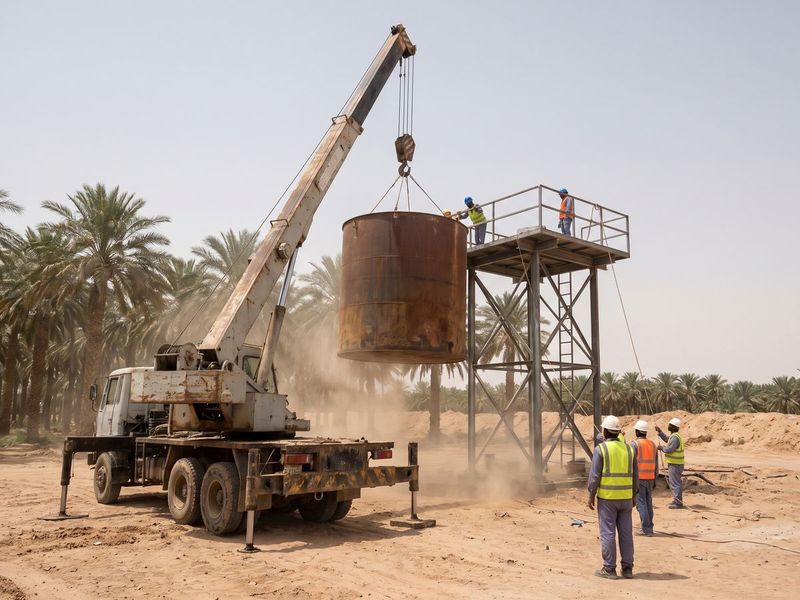
A message like this is enough: "Hi, I need a steel tank lifted onto its stand at the farm. A power line on poles runs along the track beside where the crane would stand. Two photos of it attached. I've contacted the electricity company and I'm waiting to hear back. Location link below."
Send us, in one message:
- What the load is, its weight, and exactly where it goes.
- A map link to the site.
- Two photos of the line from different sides, showing the pole and where the crane would stand.
- Where the line is relative to the crane: overhead, between the crane and the landing spot, or off to one side.
- Whether you have contacted the Saudi Electricity Company and what they said, and whether there is another setup spot further from the line.