Moving a shipping container by crane, step by step
This is what happens between your first message and the box sitting level in its new spot. The first two steps are yours:
- Before the day: send its size, a photo of the door markings, whether anything is inside, and map links for both sites.
- The day before: empty it or secure what stays inside. If it's an office or a room, have an electrician cut the power at the source and an AC technician take the AC unit off, and remove the steps and shade.
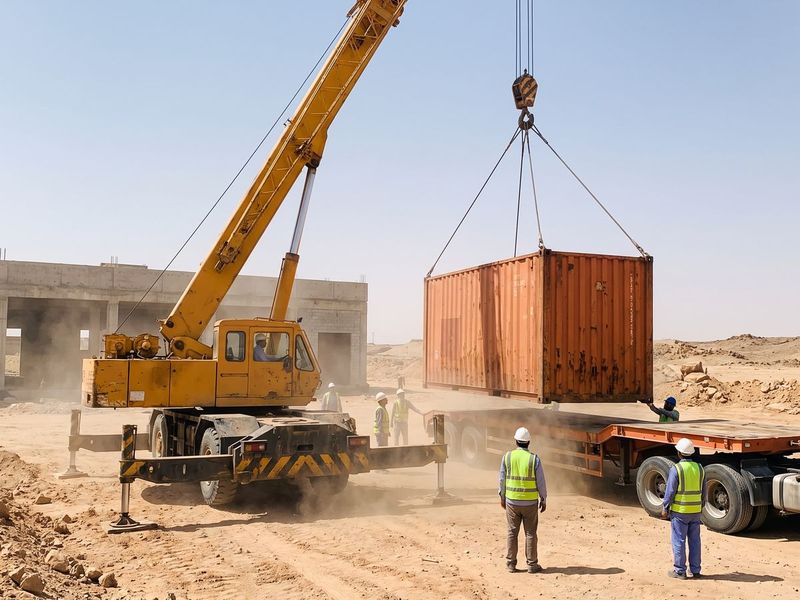
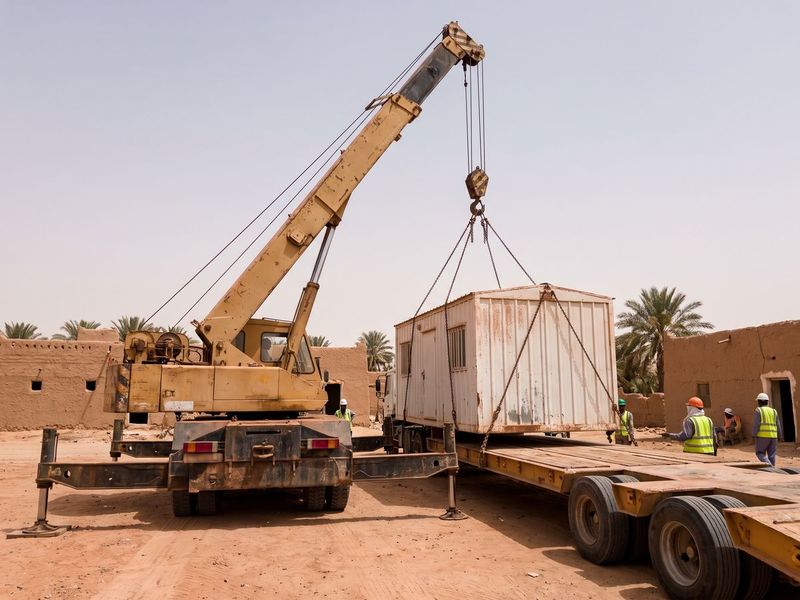
- The lift: the crane sets up on firm ground nearby and the operator attaches the gear at the corners. How it's rigged is the operator's call.
- Loading: it's lowered onto the lowbed or flatbed and chained down before it moves.
- Set-down: the crane lifts it off the trailer and lowers it onto the base, sitting on all four corners.
How much does an empty 20 ft or 40 ft container weigh? Read the door
Don't take a weight from a website: it varies with the container's type, maker and condition, and the answer is painted on your own box. Length comes from the name: a 20 ft container is roughly 6 metres long and a 40 ft roughly 12, going by the size code table of the Bureau International des Containers (BIC).
BIC, which registers container owner codes worldwide, also explains the markings a container carries. The ones that matter for a move:
| On the container | What it means | Why it matters |
|---|---|---|
| TARE | Its weight when empty | Good for an empty, unmodified box |
| MAX GROSS | The most it may weigh with its contents | A ceiling, not today's weight. Never load past it |
| PAYLOAD or NET | The most it may carry inside | A guide only; what counts is what's actually inside |
| Height or high cube warning | Taller than a standard box | It rides higher on the trailer, which matters under bridges and cables |
| CSC SAFETY APPROVAL plate | Usually on the left door. The International Convention for Safe Containers (CSC) requires it on containers in international transport, with the date of manufacture and the maximum operating gross mass, which is the same limit as MAX GROSS, not the payload | If years on a farm have faded or rusted the door markings, photograph the plate |
Empty or loaded, storage box or site office
An empty box spreads its weight across its frame. A loaded one can weigh several times as much, and the goods are rarely spread evenly, so it can tip to one side as it leaves the ground. Empty it if you can; if not, don't guess the cargo weight, and never load it past the MAX GROSS figure on its door.
A container turned into a room or an office is prepared much like a cabin, as the guide to moving a portable cabin explains. What changes by type:
| Container | What changes | Before the day |
|---|---|---|
| Empty | The door figure is close to the real weight | Check it really is empty, and lock the doors |
| Loaded with goods | Heavier, and possibly heavier at one end | Get the cargo weight from the shipping papers; the operator decides whether it can be lifted loaded |
| Office or room | Insulation, AC and furniture add weight the door doesn't show | Remove heavy furniture, have an electrician cut the power at the source, list what's been added |
| Refrigerated (reefer) | The cooling unit makes one end heavier | Have a technician disconnect it, and mention it's a reefer |
How a shipping container is lifted with a crane
Many people in Ar Rass ask for a «ونش», a winch, when they mean a mobile crane with its operator, and that's what lifts a container. Some mean a boom truck, called «ونش دينا» here: a truck with a lifting arm whose limits depend on that arm, so don't assume it will manage a 40 ft or loaded box. What decides is the weight, the distance from where the crane stands, and its load chart, as the guide to crane capacity and load charts explains.
Containers are built to be lifted by their corners: each corner has a cast steel block with openings, called a corner casting. BIC notes that the CSC sets criteria for when the state of those fittings takes a container out of service, so photograph them from the ground, without climbing on the box, and point out any rust or cracks. The rigging is the operator's call. What should never happen:
- Lifting it by the doors, the roof or a chain wrapped around it.
- Dragging it with a loader, shoving it with an excavator, or carrying it on a bucket. The floor and corners get damaged, and it can tip onto someone.
- Lifting it with an ordinary warehouse forklift. The pockets under some containers are for forklifts made to handle containers.
- Anyone under it, or between it and a wall, while it hangs.
Setting the container down: level ground and a base
The box should go straight from the crane onto its spot. If that spot isn't ready, you either pay for a second lift later or keep the crane waiting. The rest of the site work is in the checklist for preparing your site for a crane. The landing spot needs to be:
- Level: a container stands on its four bottom corners. With one corner in the air, the frame can twist slightly and the doors may stick.
- Firm: soft sand or recently filled ground can settle under the corners over time.
- On a base: blocks or concrete pads under the corners, or a slab, depending on the weight and how long it stays. For a permanent office or home, or a box that will carry another, ask an engineer first.
- Slightly raised, so rainwater and sand don't collect underneath.
- Facing the right way, with room for the doors to swing fully open. Mark the spot on the ground.
- Clear of septic pits, underground tanks and buried pipes. The same goes for the crane's spot.
At both sites: can the crane and the trailer reach it?
Many containers on farms and rest houses were set down years ago, and walls, shades and power lines have gone up around them since. Check both sites before you book:
- The crane's spot: flat, firm ground close to the box and the landing spot. Further away means a bigger crane.
- The gate: a 40 ft container on a trailer is a long load that needs room to get in and turn.
- Power lines: don't judge the distance by eye. Tell the operator in your first message, and contact the Saudi Electricity Company if a line is in the lift's path.
- What holds it down: sand banked against its sides, concrete or welds. All of it has to be dug out, broken out or cut free before the day.
- Near houses: a hanging load never passes over people. If the only path for the load runs over a house or a majlis, say so from the start; the operator decides the route.
Do you need a permit to set a container down?
We couldn't find a published rule we can confirm for every case, and it may differ between municipalities, so we won't guess. Ask your municipality, or check the Balady platform, before the day, especially when:
- The crane will stand on a public street or close part of it.
- The container will sit on a pavement, outside a shop, or on land you don't own.
- It will become a fixed office, room or home rather than temporary storage.
Lowbed or flatbed for a container, with the crane in the same booking
Both work. What decides is the overall height: the container plus the deck. A high cube on a high flatbed can end up too tall for a bridge or cable on the route, while a lowbed carries it lower; the lowbed vs flatbed guide shows how to work it out. If a modified box is wider or taller than standard, say so before you agree, and ask the Transport General Authority about road size limits.
A container can't climb onto a trailer, so the crane is part of the move, not an extra. We have both cranes and lowbeds, with operators and drivers, so lift, drive and set-down come in one booking instead of two firms waiting on each other. What each move takes:
| The move | What it takes | Watch for |
|---|---|---|
| Within one site | A crane alone, if both spots are within its reach | The spot furthest from the crane sets its size |
| Site to site | A crane at both ends, plus a lowbed or flatbed | The same crane travels with the trailer, or a second one waits |
| Arriving by truck from a supplier | A crane at the landing site | When the truck arrives and where it stops |
What to send on WhatsApp for a clear price
Our cranes and lowbeds go out with their operators and drivers from our yard in Al Ihtifalat, Ar Rass. We cover every city in Qassim and move loads to other cities by lowbed on request. Moving a container comes under our machinery, generator and container moving service: cranes are priced by the hour, the day or the job, lowbeds by distance and weight, and you get a clear price before we start.
A message like this is enough: "Hi, I have an empty 20 ft container, here's a photo of its door. I want it moved from this farm to this site, and the base is ready. What's the price?"
Send it all in one message:
- The size: 20 ft or 40 ft, standard or high cube (HC or HQ).
- A photo of the door markings, and of the CSC plate if there is one.
- Whether it's empty, loaded (with the cargo weight), or converted into an office or room.
- Map links for the pickup and the drop-off.
- Photos of each gate, of where the crane can stand, and of any cable nearby.
- Whether the base is ready, and whether the box is fixed to the ground.