Farm equipment transport: what drives on and what needs a crane
Before you ask for a price, work out how each machine gets onto the trailer. That decides whether you need a lowbed alone or a lowbed and a crane. The maker's manual, the lowbed driver and the crane operator have the final word; this is the general picture:
| Machine | How it gets on | What to watch |
|---|---|---|
| Tractor that runs | Drives up the ramps, with someone who knows it at the wheel | Rear implement off first; duals and ballast add width and weight |
| Tractor that won't run or has weak brakes | By crane, from the lifting points in its manual | Real weight; where a crane can stand at both farms |
| Wheat combine | Drives up if it runs; the header travels separately | Width even without the header; grain tank empty |
| Alfalfa harvester or baler | Self-propelled: drives up. Towed: lifted on | No bales left inside, moving parts locked |
| Plough, disc, seed drill, sprayer | By crane or lift, each tied down separately | Sprayer rinsed and empty, seed drill empty |
| Well pump engine or generator | By crane at both farms | Disconnected by its technician first; weight from its plate or supplier |
| Diesel or water tank | By crane, empty | Liquid inside adds weight and shifts on the road |
| Centre pivot spans | Dismantled by the pivot technicians; long sections lifted by crane | Section length, and a deck long enough |
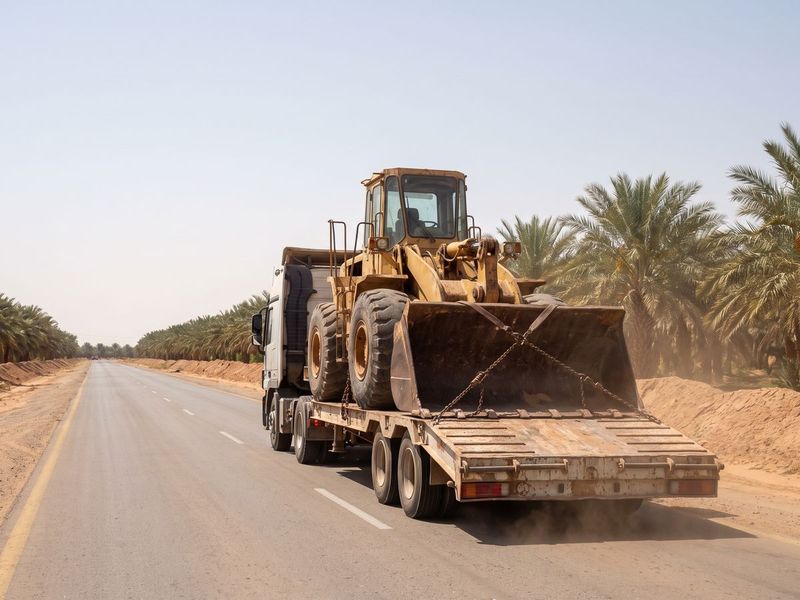
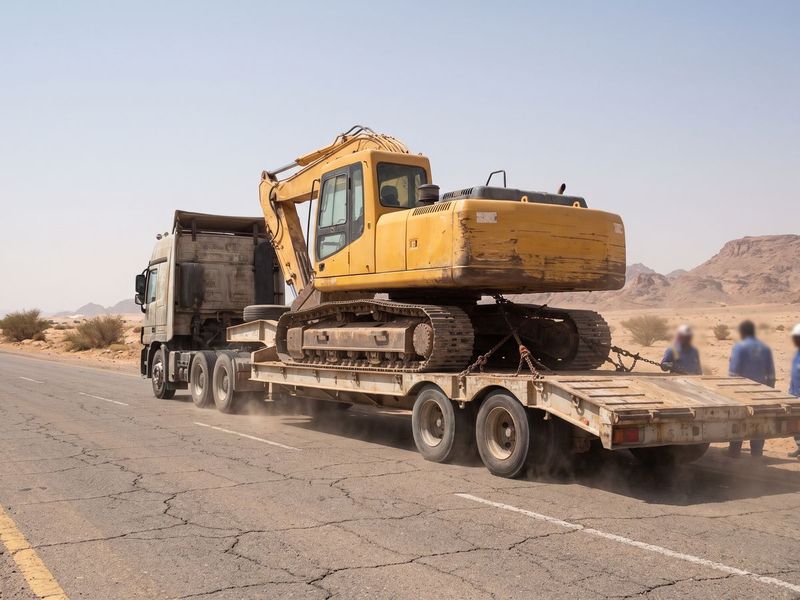
| The farm's loader or excavator | Drives up the ramps | Its transport position is in the guide to moving an excavator or loader on a lowbed |
Moving a tractor on a lowbed: get it ready first
A tractor is the easiest farm machine to move when it's ready, and the one with the most surprises when it's left until moving day. Before the lowbed arrives, you or whoever drives the tractor:
- Take the implement off the rear hitch, whether it's a plough, a disc or a leveller. It travels tied down on its own unless the lowbed driver decides otherwise.
- Lower the front loader's bucket onto the deck or take the loader off, as the manual says. Nothing stays held up on hydraulics, and the PTO shaft is secured or removed.
- Mention front weights, water in the tyres and dual wheels. The first two are weight the plate doesn't show; duals add a lot of width.
- Measure the height from the ground. The highest point is often the exhaust stack, the roll bar or a beacon, not the cab roof.
- Clean the mud off the tyres, clear loose tools and jerry cans from the cab, and check the brakes and steering. Say upfront if it leaks oil or diesel: oil on the ramps makes a tyre slip.
- Agree who drives it up: someone who knows the tractor, with the lowbed driver signalling and choosing where it stops. Everyone else keeps clear of the ramp sides and the front.
- Securing the tractor for transport is the lowbed driver's job: he chains it front and back at the tie-down points its manual shows. You don't touch the chains, but tell him if you see one wrapped around a hydraulic hose or cylinder, a loader or implement left loose, or anything sticking out past the deck.
How to transport a combine harvester: the header comes off, and width is the issue
A wheat combine is usually the widest, longest machine on the farm, and it doesn't travel the way it works. The header normally comes off and moves separately, on its own cart or on the lowbed. Removing it is a job for its operator or the dealer's technician, following the manual, not something to rush on the morning of the move.
Even without the header a combine is wide, so measure it in transport position, and the header separately. A load wider or longer than usual may need a permit and special arrangements. We couldn't confirm the legal limits from an official source, so ask the Transport General Authority what applies. If your load is oversize, we tell you what it needs before we set off.
- Grain tank completely empty: leftover grain is extra weight and ends up on the road.
- Unloading auger folded and locked, mirrors and folding steps tucked in.
- Chaff and straw cleared from around the engine and exhaust, or it blows off on the way.
- Alfalfa harvesters and balers are the same: no bales inside, moving parts locked, and anything towed travels on its own.
Implements: ploughs, seed drills and sprayers travel separately
Implements look small next to a tractor, but sharp edges and awkward shapes make them harder to tie down than a whole machine. Tying down is the driver's job; yours is to get them ready and count them:
- List every piece: plough, disc, seed drill, sprayer, leveller, trailer. A piece nobody mentioned may have no place on the deck.
- Rinse and empty the sprayer as the chemical's label and the sprayer's manual say, away from the well and irrigation channels, because chemical residue is a hazard for the driver and other road users. Fold and lock its booms as the manual shows.
- Empty the seed drill and the fertiliser spreader. What's left adds weight and leaks out on the way.
- A few light implements may only need a flatbed; weight, height and the number of pieces decide. The lowbed vs flatbed guide explains the difference.
- Don't lift an implement onto the trailer with a loader bucket. It can slide off or tip onto whoever is nearby. Lifting needs a crane or a lift with its operator.
Well pump engines, generators and tanks: all by crane
None of these move on their own, so a crane lifts them on at the first farm and sets them down at the second. We have both the crane and the lowbed, so it's one order instead of two companies to coordinate. Before the day:
- Pump engine or generator: your electrician or mechanic disconnects the wiring and pipework before we arrive. We lift, move and set down; the wiring at both ends is your technician's job.
- Submersible pump: pulling it out of the well is the well technician's job with his own equipment, and isn't covered here. Once it's out, list the pump and the pipes with their length.
- Weight: from the plate, the invoice or the supplier, never a guess from its size. The crane is chosen by the weight and how far it sits from where the crane stands.
- Where the crane stands at the well, generator or tank: firm ground that hasn't just been irrigated, and look up. If a power line runs over or near the lift spot, mention it in your first message and contact the Saudi Electricity Company before the day. Don't judge the gap by eye; the operator decides where the crane stands, and if he says it isn't safe, the lift waits.
- Empty a diesel tank before it moves, and allow no welding or cutting on it afterwards unless a qualified technician says it's safe: fuel residue can ignite. Empty a water tank too, as water sloshing inside shifts the load.
- If the tank goes onto a steel stand at the new farm, the stand must be finished and checked first. The guide to lifting tanks, including farm tanks on stands covers it.
The farm track: the last stretch is what stops a lowbed
The highway between two farms is rarely the problem. The dirt track into the farm and the loading spot are. A loaded lowbed is heavy, long and low, so small things stop it. Check these at both farms and photograph them:
| On the track | Why it stops a lowbed | Before the day |
|---|---|---|
| Soft sand or freshly watered ground | All the weight is on the tyres and it can sink | Don't irrigate next to the track before the move; let it dry |
| A channel or culvert across the track | One that takes a tractor may not take a loaded lowbed | Mention it and let the driver decide |
| Irrigation pipes on the ground | They break under the tyres or catch under the low deck | Move them off the track |
| Palm fronds over the track | They hit the top of the load, and cabs sit high | Trim them, or photograph them so the height is planned for |
| A power line into the farm | The top of the load can come close to it, and that puts lives at risk | Don't judge the gap by eye. Mention it in your first message and contact the Saudi Electricity Company before the day |
| A narrow gate, or nowhere to turn | A loaded trailer is long and may have to reverse a long way out | Measure the gate and mark a turning spot |
| A sloping or sandy loading spot | A machine can't climb the ramps safely on a slope | Prepare firm, level ground with room behind the ramps |
- The second farm needs the same, and people forget it. Decide where each machine goes, and have someone there to open the gate.
- While loading and unloading, everyone stays clear of the ramps, the back of the lowbed and any suspended load.
The tractor drives fine. Why put it on a lowbed?
If the two farms are next door and joined by an internal track, plenty of farmers simply drive the tractor over; that's your call. A highway or a long distance changes the sums. A slow tractor in fast traffic endangers its driver and everyone else, especially at night or in dust; a combine, or a tractor with an implement on, takes more than its lane; and a long drive wears the tyres and costs your driver a working day.
If implements or a pump engine go by lowbed anyway, the tractor may fit on too, if the driver says the weight and space allow. Unsure whether your tractor may use a particular public road? Ask the Traffic Department first.
More than one machine? What sets the price?
Lowbed transport is priced on the distance between pickup and drop-off, the weight and size of what's moving, and whether a crane is needed. So with a tractor, its implements and a pump engine, list them all in one message; that shows whether it's one trip or more.
The date depends on what's free that day, so if a machine has to be there before ploughing or harvest, ask early and have everything ready. A machine still waiting for its header to come off or its tank to be emptied holds up the lowbed and the crane. You get a clear price before we start, and the lowbed transport cost guide covers every part of it.
What to send on WhatsApp to move your farm equipment
Our lowbeds and cranes go out with their drivers and operators from our yard in Al Ihtifalat, Ar Rass. We cover every city in Qassim and move loads to other cities by lowbed on request. Our lowbed transport service brings the crane in the same order when a machine can't drive itself.
A message like this is enough: "Hi, I have a working tractor (plate photo attached), a plough, a seed drill and a disconnected well pump engine to move from this farm to this one. Photos of both entrances attached."
Send us, in one message:
- Every machine that's moving: type, model and a photo of its plate.
- Whether the tractor or combine starts and drives, or has a fault.
- The implements by name, and whether they and the header will be off before the day.
- The weight from the plate or invoice, any ballast or water in the tyres, and the size in transport position if you know it.
- Map links for both farms.
- Photos of the track and entrance, the loading and drop-off spots, and any cable, fronds or channel on the way.
- Who drives the machines at loading and unloading, and when suits you.