Before moving an excavator on a lowbed: get it ready
Do this before the lowbed arrives, so you're not paying for it to stand around:
- Clean mud, sand and stones off the tracks or tyres. Mud makes a machine slide on the ramps, and what's packed in the tracks ends up on the road.
- Check it starts, drives and brakes normally. If it has a drive fault or a hydraulic leak, say so at the start.
- Clear anything loose out of the cab and off the machine: tools, jerry cans, spare parts.
- Mention any breaker or second bucket travelling with it. It adds weight and needs its own tie-down.
- Photograph the plate showing the model and weight, and keep the maker's manual to hand. It shows the transport position and tie-down points for your machine.
- Have firm, level ground ready for the lowbed, with room behind the ramps for the machine to line up.
Who drives the excavator onto the lowbed? Settle it first
It's the question people forget, and it can stall the job on site. The lowbed comes with its driver, who knows where to park the trailer, where the machine has to sit for its weight to spread properly, and how to tie it down. But the excavator is yours, and it's best driven on and off by an operator who knows how it handles.
So decide beforehand who drives it at loading and who unloads it at the other end. If your operator is meeting the lowbed there, they need to arrive before it, not after.
While the machine is on the ramps, one person gives the signals from a safe spot. Everyone else, the owner, the workers and anyone watching, keeps clear of the ramp sides, the front of the machine and the back of the trailer. If it slips or tips, there's no time to step away.
Transport position: an excavator isn't a wheel loader
Every machine has a position it travels in, and the authority on it is the maker's manual for your machine, not habit and not something online. The idea is the same for all of them: anything that moves goes down onto the deck or gets locked, so it can't shift on the road or add height. Here's what that means machine by machine:
| Machine | How it sits on the lowbed | What to watch |
|---|---|---|
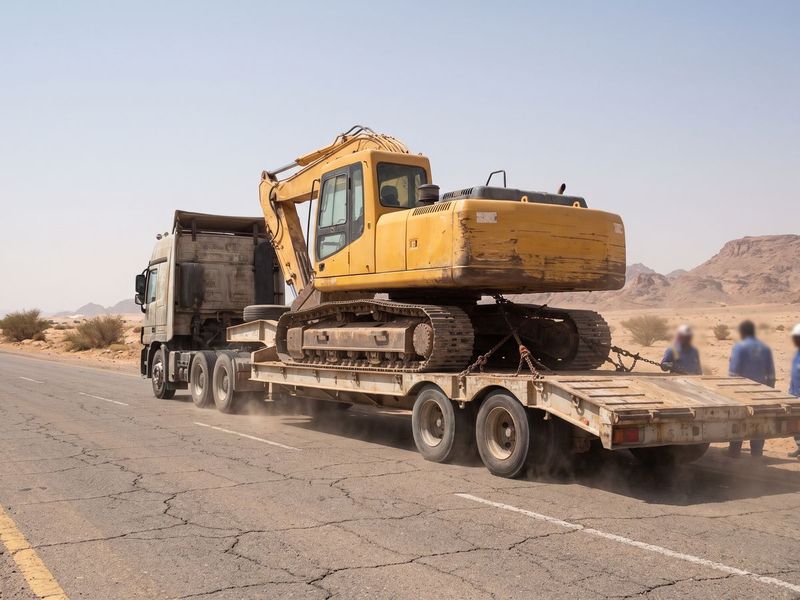
| Excavator | Upper body lined up with the tracks, boom and arm folded, bucket resting on the deck. Swing lock on if it has one. | The height of the folded boom, often the highest point, and the track width. |
| Mini excavator | Same as a full-size one: arm folded, bucket down, front blade lowered onto the deck. | A small machine is chained just as seriously. It may not need a lowbed at all: see which trailer suits which load. |
| Wheel loader | Bucket down on the deck, and the articulation lock in the middle fitted so the loader can't fold while it's chained. | Bucket width, which is usually wider than the tyres. |
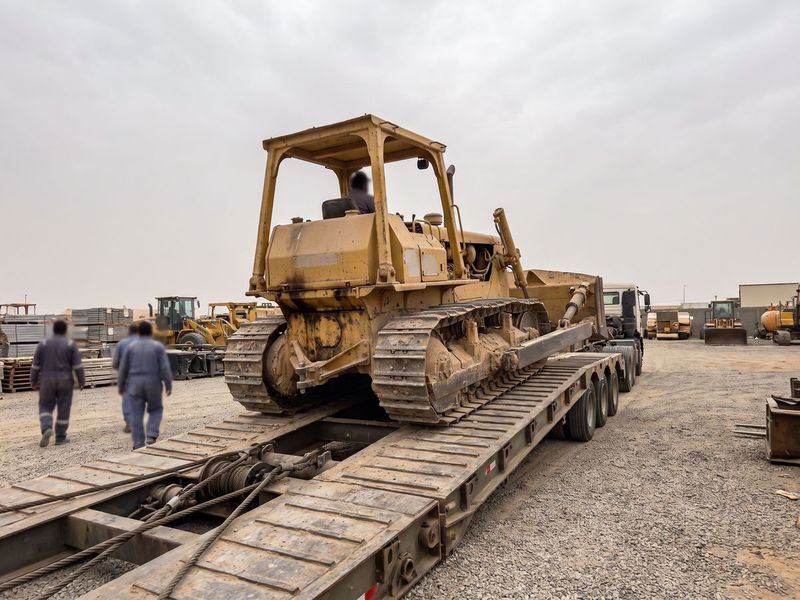
| Bulldozer | Front blade lowered onto the deck, and the rear ripper down if it has one. | It's heavy for its size, the blade is often the widest point, and mud and stones collect in the tracks. |
| Grader | Blade in the transport position the manual shows, inside the machine's width, articulation lock fitted. | Its length, and the room it needs to turn at gates. |
| Backhoe loader | Front bucket down, rear arm folded and locked, stabiliser legs raised. | It has two working ends, and each has its own position. |
| A machine that doesn't run | It can't climb the ramps. It's lifted by crane from the lifting points the manual specifies. | Its real weight, and where a crane can stand at both sites. |
- On every machine: engine off, parking brake on, key with the operator, doors and windows shut.
- If you don't know your machine's transport position, ask the dealer before the day, not while it's sitting on the ramps.
Loading an excavator on a lowbed: what you should see
The loading itself is the operator's and the lowbed driver's job, and this guide won't tell you how to do it yourself. What's worth knowing is what a job going right looks like:
- The lowbed is parked on firm, level ground, not on sand and not on a slope. The ramps sit solidly on the ground, free of mud and oil.
- The machine comes onto the ramps straight and slowly, with one person signalling.
- It stops on the deck exactly where the driver says, not just anywhere. That position is what spreads the weight across the axles.
- Once it has stopped, the bucket and blade go down onto the deck, the engine goes off, and only then does tie-down start.
- What not to do: don't ask to load on a slope to save a trip, don't build a ramp from soil or timber, and don't stand beside the ramps filming. If the driver repositions the machine more than once, don't rush it. That adjusting is the job.
Tie-down: how to tell the chains are right
The machine is chained and strapped down at the front and the back before it goes on the road. Most machines have dedicated tie-down points on the frame, and the manual shows where. Tying down is the driver's job and you don't need to touch anything, but you can spot a few things worth pointing out:
- A chain wrapped around a hydraulic hose or a cylinder. That's the wrong place: it isn't built for that pull and can break or start leaking.
- A bucket or blade left hanging in the air instead of resting on the deck.
- A breaker or other attachment sitting next to the machine without its own tie-down.
- Something sticking out past the trailer's width, a mirror or the edge of a bucket, that nobody mentioned.
- Chains can slacken a little as the machine settles once it moves, so ask whether the tie-down gets checked again a short way into the trip.
On the road: height, power lines and permits
On a lowbed, the height that counts is the machine's plus the deck's, and that's the figure compared against bridges and cables on the route. The lowbed vs flatbed guide shows how to measure it.
Farm roads in particular have low power lines crossing the track or running into the farm, and if the boom touches one, everyone around it is in danger. Don't judge the gap by eye. Mention any line at the start, and ask the Saudi Electricity Company about a low one on your route.
A machine that is unusually wide, long or heavy may need a permit and extra arrangements before it moves. We couldn't confirm the legal limits from an official source, so ask the Transport General Authority what applies to yours. With a large load, we explain what it needs before we set off.
Unloading: the second site needs the same preparation
People prepare the loading site and forget the drop-off. The lowbed needs the same things there: an entrance it fits through, firm level ground to park on, and room behind the ramps for the machine to come down and move away.
- Decide exactly where the excavator goes, and photograph that spot and the entrance before the day.
- If the ground is sandy or freshly filled, say so. A loaded lowbed is heavy and can sink.
- Clear the machine's path: irrigation pipes, steel, building materials.
- Have the operator there, because unloading is loading in reverse, and the same people keep clear.
- The chains come off only once the lowbed is parked and settled. If the machine is going into a tight spot or between palm rows, say so when you book.
Excavator won't start? Don't drag it up the ramps
A machine that won't start or won't drive can't climb the ramps. Some people pull it up with another machine or push it with a loader, which puts it on the ramps with no control and no brakes. It can slide off or tip onto whoever is nearby.
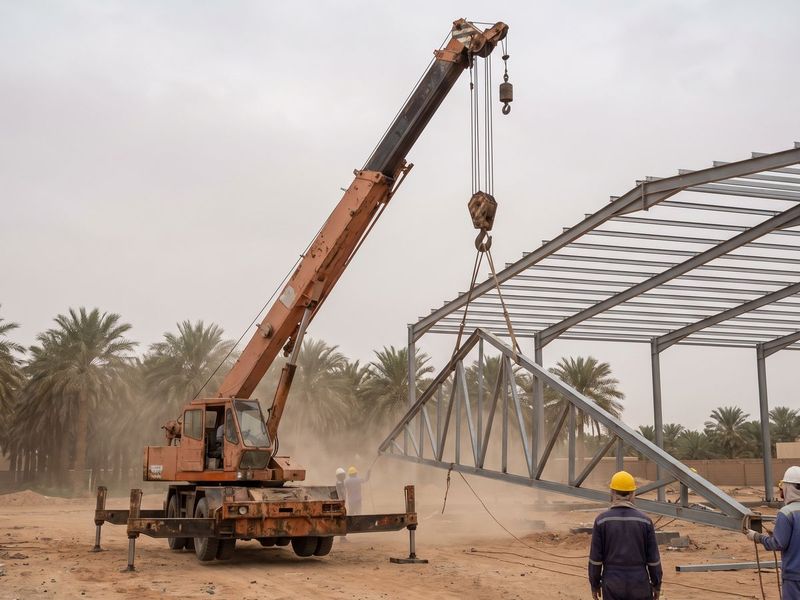
The safe way is a crane with its operator lifting it onto the lowbed and setting it down at the other end, from the lifting points in the maker's manual. Whether a crane can lift it from where it sits depends on its real weight, the distance from where the crane can stand, and that crane's own load chart, never on a guess. The crane capacity guide explains how that's worked out.
We have both the crane and the lowbed, so the lift, the move and the set-down come in one order. Send a photo of the plate, exactly where the machine is parked and a picture of the space around it, and tell us what's wrong: it won't start, it starts but won't drive, or a track is off. Each one is handled differently.
Moving loaders and dozers between farms, and what it costs
In Qassim a lot of machine moves are from one farm to another, or from a farm to a project. The distance is often short, but the last stretch is the hard part: a dirt track, a narrow gate, palm trees, cables running into the farm. A photo of each farm entrance sorts most of this out before anyone sets off.
Lowbed transport is priced on the distance, the machine's weight and size, and whether a crane is needed. Moving more than one machine? List them all in the same message. The lowbed transport cost guide covers every part of the price.
What to send us on WhatsApp to move your excavator
Our lowbeds go out with their drivers from our yard in Al Ihtifalat, Ar Rass, cover all of Qassim and move machines to other cities on request. Our lowbed transport service brings the crane in the same order when your machine doesn't run, with a clear price before we start.
A message like this is enough: "Hi, I have a working excavator, here's a photo of its plate, and a breaker goes with it. I need it moved from this location to this one, and the operator will be at both ends."
Send us, in one message:
- The machine type and model, with a photo of its plate.
- Whether it starts and drives itself, or has a fault.
- Any attachments travelling with it.
- Its length, width and height in transport position, if you know them.
- A map link for the pickup and another for the drop-off.
- Photos of where the machine is, the entrance at each site and the spot it's going to.
- Who will drive the machine at loading and unloading, and when suits you.