Factory machine relocation, step by step
From the first list to the machine running in its new place. Our part is the lift, the transport and the set-down. Disconnecting, reconnecting and commissioning belong to the factory's technicians or the machine's agent:
| Stage | What happens | Who |
|---|---|---|
| Inventory | Every machine listed with its weight, size and new spot | The plant manager |
| New building | Floor, foundations, power and air ready at each spot | Engineer and contractor |
| Disconnect | Power, air and fluids off, moving parts locked, connections labelled | The technicians or the agent |
| Out of the hall | To open ground or a wide door the crane can reach | Depends where it sits (below) |
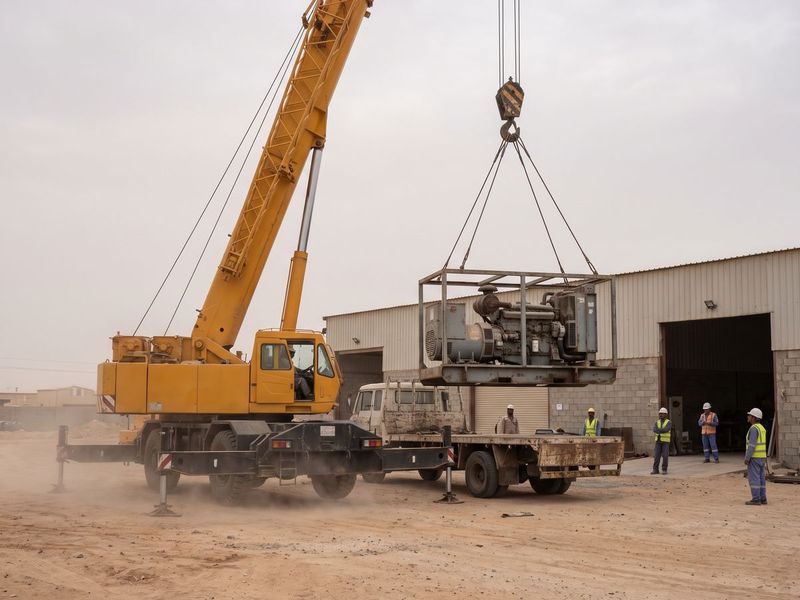
| Lift and load | Rigged at its lifting points, lifted onto the lowbed, chained down | Operator and driver |
| Set down | At the agreed spot at the new site | Crane operator |
| Into place | From the set-down spot to its place in the hall | As on the way out |
| Level and start | Levelled, anchored, reconnected and test-run | The technicians or the agent |
Start with an inventory, and number everything
A plant that moves without a list loses a day with the crane standing idle. Give each machine one line. It's the same list you send us, and it decides the crane, the trailer and how many days to book:
- A number, written on the machine, on its marked spot in the new building and on every box of its loose parts.
- Its name and model, with a photo of the nameplate.
- Its weight, and where that figure came from.
- Length, width and height, and whether it splits into smaller pieces.
- Where its lifting points are, if the maker marks them.
- Its place in the order. With many machines, move in batches, each fully ready before its day, starting with the ones production depends on so the new plant runs while you finish the rest.
Disconnecting: power, air, fluids and anything that moves
Disconnecting isn't the crane operator's job, and it isn't left for moving day. The factory's technicians or the machine's agent finish it beforehand. Many makers' manuals have a transport section on what to lock and what to drain, so read it first.
- Power: isolated at the panel that feeds the machine, not just switched off at its button. Disconnecting and reconnecting is an electrician's job.
- Cables: photograph every connection and label each wire before it comes apart, so reconnecting isn't guesswork.
- Compressed air and water: lines closed and pressure released first.
- Oil and coolant: drained or left in, as the manual or the agent says. Tell us if any fluid stays in, because a leak on the deck is slippery.
- Moving parts: tables, heads and doors locked with the transport brackets that came with the machine, or as the agent says.
- Loose parts: taken off and boxed under the machine's number.
- Floor bolts: every one out before the lift. A machine still bolted down is never lifted, and the operator checks before taking the strain.
How much does the machine weigh? Don't guess
Weight comes first because it decides the crane and the trailer. Take it from the nameplate, the manual, the purchase invoice or the shipping papers, or ask the agent with the model number. Then watch for this:
- The figure may be for the bare machine. Its base, attachments and oil come on top.
- Weight isn't spread evenly. A heavy head on one side puts the centre of gravity off centre, which changes how it's rigged, and that's the operator's call.
- A machine far from the crane needs a bigger crane than a close one of the same weight, because a crane lifts less the further it reaches. The guide to crane capacity and load charts explains why.
- No figure anywhere? Send the model, photos and dimensions and we work it out with you before anyone sets off.
Getting it out of the hall: where can a crane reach?
A mobile crane stands outside on firm ground and lifts from open ground or in front of a wide door. A machine at the back of a hall has to come out to it first. The usual pattern, with photos and dimensions settling each case:
| Where the machine sits | What usually gets it out | What to watch |
|---|---|---|
| In a yard or under an open shade | The crane lifts it straight onto the lowbed | Firm parking close by, and no lines overhead |
| In a hall with an overhead crane | The overhead crane brings it to the door, the mobile crane takes over | Stay within the load marked on the overhead crane |
| In a hall without one | A lift if the weight suits, or a machinery moving crew with skates and jacks | The floor to the door, and the door's size |
| A small machine on a pallet | A lift may do the whole job | Its weight within the lift's capacity |
- Measure the door against the machine as it sits on whatever carries it out, not the machine alone, and walk the route for trenches, pit covers and thresholds.
- Never drag a machine with a loader, push it with an excavator bucket or improvise with ropes. It can tip, and anyone near it is in danger.
- We rent out lifts with operators too, so if the weight suits a lift, say so and we'll check with you whether it's enough.
The new building: floor, foundations and anchor bolts
What wrecks a moving day most is a machine that arrives before its spot is ready and gets lifted twice. Ready the new building before the old one comes apart:
- The floor: whether the new slab carries a heavy machine is a question for a structural engineer, not a guess. Very heavy machines, and ones that vibrate, usually need their own foundation, designed from the maker's foundation drawing.
- New concrete: it must have gained its strength before a machine goes on it. The engineer says when.
- Anchor bolts: set out to the maker's foundation drawing and checked before moving day.
- Each spot marked with the machine's number and the way it faces, with room around it for maintenance and its doors, as the manual asks.
- Power, air and water already run to each spot.
Lowbed or flatbed, tie-down and protection on the road
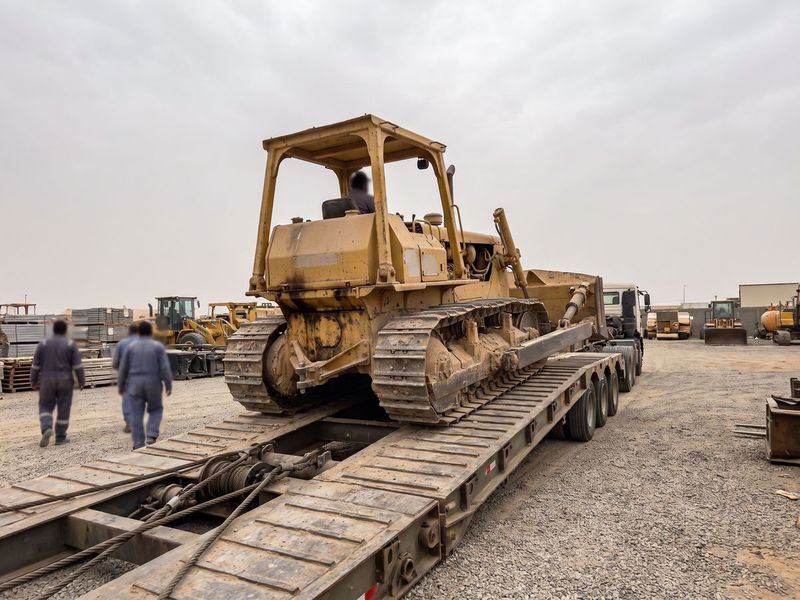
Most heavy machines travel on a lowbed, because its low deck keeps the overall height down, and that height is what counts under bridges and power lines. Lighter, lower machines may fit a flatbed. The lowbed vs flatbed guide compares the two in full.
On an open trailer a machine meets dust and sometimes winter rain, so cover control cabinets and screens and close openings. Chains go on the base or the maker's points, never on pipework or covers, and the driver decides the tie-down.
If the machine is wider, longer or heavier than usual, it may need a permit before it moves. We don't print legal limits here, because we couldn't confirm them from an official source. Ask the Transport General Authority, and give us the dimensions at the start.
On the day: where the crane parks at both sites
Industrial streets are busy with trucks, yards collect scrap, and lines sometimes run overhead. Check both sites before you book. The full list is in the guide to preparing a site for a crane:
- Crane parking: firm, level ground near the door. Mention any tank, septic pit or trench under the yard in your first message.
- Power lines: photograph any line near the crane or the lifting path, and don't judge the gap by eye. If one is close, contact the Saudi Electricity Company first. If the operator says it isn't safe, the lift waits.
- The gate: room for the crane and the lowbed to get in, turn round and get back out.
- The street: if the crane will block part of it, tell your neighbours and ask the municipality whether you need permission. Inside an industrial city, ask its management.
- People: nobody stands or walks under a machine while it hangs, and other work around the lift stops until it's down.
- Someone from the factory at both sites who knows the layout and decides where each machine goes.
Setting down, levelling and the first run
The crane sets the machine down at the agreed spot: on its foundation if it can reach, or at the door for whoever takes it inside. Then the technicians level and anchor it, refit what came off, and reconnect it from the photos and labels made at the start.
Don't put it straight into production. Take the transport brackets off first, then let the technician run it and check its settings, because the lift and the road can shift things. Keep the brackets with the machine for the next move.
What sets the price of moving factory machines
Cranes are priced by the hour, the day or a fixed price for the job, and lowbeds by distance and weight. You get a clear price before we start. In a plant move, what usually changes the price is:
- The weight of the heaviest machine and its distance from where the crane parks, which decide the crane size.
- How many machines there are, and how many lowbed trips they take.
- The distance from Ar Rass to the old site and between the two sites, and whether a crane is needed at both ends.
- How ready the machines are. If the crane is booked by the hour, every hour it waits for a machine still wired in comes out of your time.
- How hard the sites are: a tight gate, sand, or lines nearby.
What to send us on WhatsApp
Our cranes and lowbeds go out with their operators and drivers from our yard in Al Ihtifalat, Ar Rass, to every city in Qassim, Buraidah included, and to other cities by lowbed on request. Our machinery moving service brings the crane and the lowbed in one order, from the lift until the machine is down at its agreed spot. Generators have their own guide: moving a generator.
A message like this is enough: "Hi, we have four machines to move. Here's the list with weights, sizes and nameplate photos. Our technicians will disconnect them first and the new building is ready. From this location to this one: what's the price, and when can you come?"
Send us, in one message:
- The list of machines: name, model and a nameplate photo for each.
- The weight of each one, and where the figure came from.
- Length, width and height, and which parts come off.
- Where each machine sits: in the yard or inside the hall, and whether there's an overhead crane.
- The door's size, and a photo of where the crane can park at each site.
- A map link for the old site and one for the new, and the dates that suit you.