What counts as an exceptional load?
The Ministry of Transport and Logistic Services, in its user guide for the permit service, puts it simply: the load and the truck carrying it, together, whose weight or dimensions go beyond the weights and dimensions set in the Saudi standards.
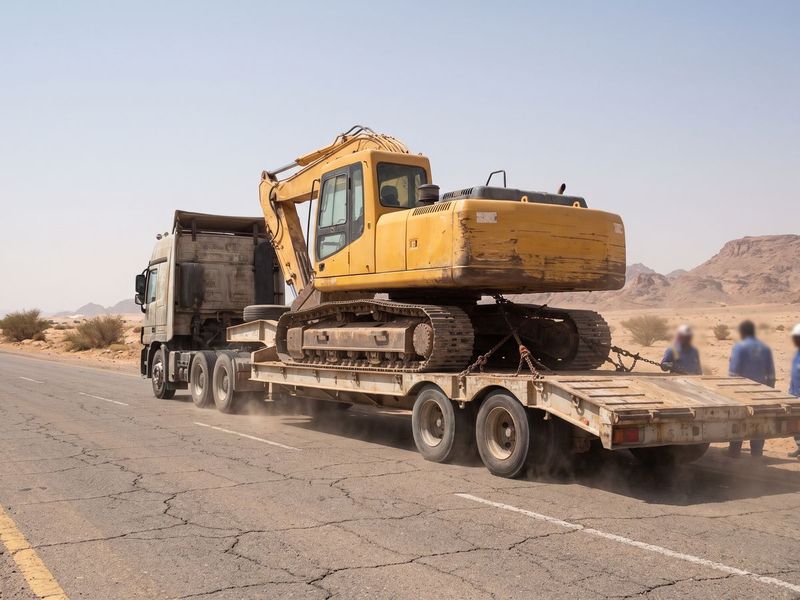
The word that matters is together. A machine that is perfectly ordinary standing on the ground can become exceptional once it is on a trailer, because the deck height adds to its height and the tractor and trailer add to its weight. That is why the same machine can need a permit on one trailer and not on another.
The Roads General Authority talks about loads that cannot be divided: things that travel as one piece, such as an excavator, a factory machine, a combine harvester or a cabin. If your load can be split, such as steel sections or pallets, ask the transporter whether spreading it over more than one trip keeps each trip within the limits.
When you need a heavy equipment transport permit: what gets measured
Four things decide it: weight, width, length and height. There is a fifth that people forget, the rear overhang, meaning how far the load sticks out past the end of the trailer. The ministry's guide asks for all of it to be measured before the form is filled in, in this order:
| What is measured | How | Why it matters to you |
|---|---|---|
| The truck on its own | Its weight, its dimensions and its rear overhang | The tractor and trailer count, not just your machine |
| The load on its own | Its weight and dimensions, ready for transport | This figure comes from you, so take it from the machine's plate, not a guess |
| Overhang once loaded | How far the load sticks out at the back once it is on the truck | An excavator arm or a long section can end up past the trailer |
| Number of axles | Entered to suit the weight carried, as the exceptional load regulation requires | A heavy load needs a trailer with enough axles, which is the transporter's job |
Why this guide prints no weight or size limits
Because we could not read them in an official text. The figures that circulate online vary from page to page, and we found one article that gives two different height limits on the same page. A wrong number here is not a small thing: if you believe your machine is inside the limits and it isn't, the road will find out. The Roads General Authority says it checks compliance strictly at the weigh stations on the road network.
The limits are set in the Saudi standards and the permit is issued by the Roads General Authority, so ask them, or ask the transporter who will file the application. If your load is wider, longer or heavier than usual, we explain what moving it involves before we set off.
Who applies for an oversize load permit: you or the transporter?
The Roads General Authority puts the obligation on carriers. That comes from its statement carried by the Saudi Press Agency in April 2026, which also said it had issued 15,297 permits for exceptional loads in the first quarter of 2026 alone, and that moving heavy equipment is one of the main cases that needs one. In other words, this is routine paperwork, not a rare event.
The application itself, according to the ministry's guide, asks for the truck's plate type and number, the vehicle owner's ID, and the driver's ID and date of birth. In practice, then, the truck's owner or the transport company files it. Your part is to hand over accurate numbers and clear photos, and to agree these points before you book:
- Who files the permit application, and when.
- Whether the permit fee is in the quoted price or charged on top.
- If approval comes late, whether the date moves at no cost to you.
- Whether the truck named on the application is the one that turns up on the day.
How the application works, step by step
The Ministry of Transport published a user guide for the online service. Here is what it describes, in our words. The Roads General Authority is the body announcing permit numbers today, so check the current channel on the authority's own site before you start:
- Log in: an account on the ministry's e-services portal, confirmed by a code sent to your mobile. For a new company account, the code goes to the owner's registered number.
- Truck and trip: plate type and number, the ministry branch for the region where the trip starts, and the city it runs from and to.
- Route: picked from a list where one exists; otherwise you write the proposed route, and the branch has to approve it.
- Owner and driver: the vehicle owner's ID, and the driver's ID and date of birth.
- The load: what it is (the guide's own example is a prefab house), with at least three photos of it on the truck, from the front, the side and the back.
- Over 90 tonnes: an extra field appears, and every requirement listed in the conditions has to be attached.
- Weight and dimensions: entered after the measuring in the table above, then you accept the conditions and undertakings and submit.
- The invoice: once approved, it must be paid within 6 days or it lapses.
- The permit: printed after payment, valid for 30 days from the payment date, and it shows the approved route.
Timing: photos, validity and when the load may travel
The photos have to show the load already on the truck, so ask the transporter when and where they will be taken. A machine that drives itself goes up the ramps and gets photographed. For a factory machine or a cabin that needs a crane to load it, ask how the photos will be handled before moving day.
After approval you have 6 days to pay, and after payment you have 30 days to use the permit. So don't take it out early and then let the move slide past the end date, and don't leave it to the last day either.
The Roads General Authority also sets the times these loads may move, to cut the risks it links to bad weather, night-time and public holidays. Don't plan the move for the eve of Eid or a dusty day, and keep to the times the authority allows.
How long does approval take? We found no published figure from an official source we could rely on, so ask the transporter and leave a comfortable gap between applying and moving day.
Inside the city and on the open road
The Roads General Authority's permits, by its own account, cover the road network outside urban areas, such as the roads between Qassim's towns. For streets inside a city, say from the industrial area to a residential district, we found no published rule we could confirm, so ask the municipality before the day.
If a crane will also stand in the street to load or unload, that is a separate question for the municipality, covered in our guide to preparing a site before the crane arrives.
Does a lowbed get you out of it? Ways to stay inside the limits
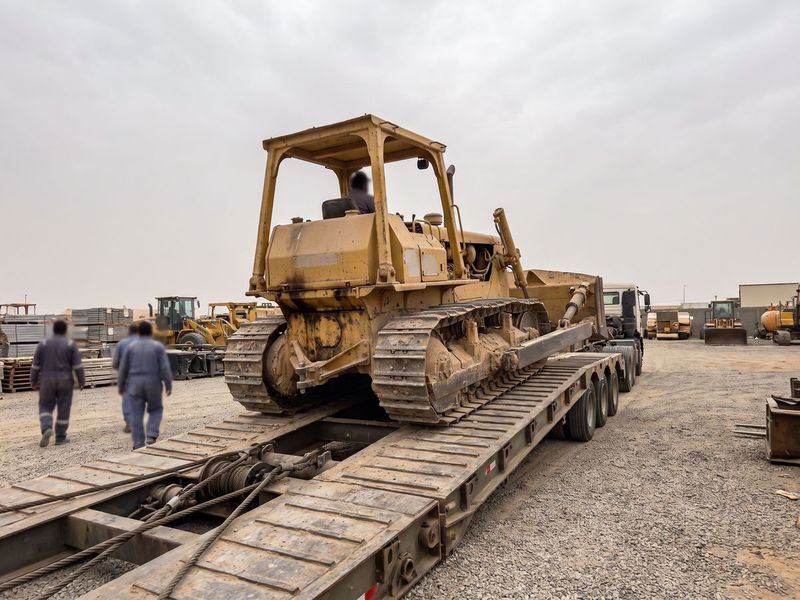
A lowbed lowers the height because its deck sits close to the road. Width stays width, weight stays weight, and the lowbed adds its own weight on top. The full comparison is in lowbed vs flatbed.
Before you assume your machine needs a permit, ask the transporter about these, because some of them bring a load back inside the limits:
- Attachments: a big bucket, a breaker or a blade adds weight, length and width. Can it come off and travel separately?
- Transport position: the excavator arm folded the way the manufacturer's manual shows, and mirrors and lights folded in where they fold.
- A lower deck: if height is the only problem, a trailer with a lower deck may solve it.
- Splitting: a load that can be divided goes in two trips instead of one trip over the limit.
- Anything bigger than that, such as counterweights or tracks, is a job for the machine's technician following its manual, not something to rush on moving day.
Loads in Qassim worth measuring early
We can't tell you that one machine needs a permit and another doesn't, because the answer comes from its measurements and weight together with the truck. These are loads we see often in Qassim, and the measurement to start with:
| Load | Measure first | Why |
|---|---|---|
| A large excavator or dozer | Weight with attachments, and width across the tracks | Heavy and wide often come in the same machine |
| A combine harvester or wide farm machine | Width, even with the header off | Width is usually what goes over, not weight |
| A large cabin or prefab room | Width, and height including the trailer deck | A tall cabin on a high deck ends up taller than you expect |
| A factory machine or large generator | Weight, and height on the trailer | One piece that can't be split, with its weight concentrated |
| Long hangar steel or trusses | Length, and how far they stick out at the back | Rear overhang counts, and steel can often be split over two trips |
Mistakes that hold up the trip
- Taking the weight from the model name. The number in the name is not the machine's weight. Take it from the plate or the manual; the equipment weights guide shows where to look.
- Measuring with the arm raised, or with a bucket fitted that will come off for transport.
- Forgetting the trailer's deck height, or the truck's own weight.
- Assuming the transporter has taken out the permit without asking.
- Paying the invoice late, or letting the move slip until the permit runs out.
- Changing the truck or the route at the last minute. The permit carries the plate number and the approved route, so ask before changing either.
- Booking the move before you know whether the load needs a permit at all.
What to send us on WhatsApp before a big move
Our lowbeds go out with their drivers from our yard in Ar Rass to every city in Qassim, and to other cities on request. If your load is wider, longer or heavier than usual, we explain what moving it involves before we set off, and you get a clear price before we start. If it needs a crane to load and unload, our lowbed transport service puts the crane and the lowbed in one booking.
A message like this is enough: "Hi, I have an excavator, photo of its plate attached, and the bucket comes off. Length, width and height in transport position are these. I want it moved from this location to this one next week. Does it need a permit?"
Send us, in one message:
- The machine type and model, and a photo of the plate showing its weight.
- Length, width and height in transport position, and any attachments travelling with it.
- Photos of the machine from the front, the side and the back.
- Map links for the pickup and the drop-off.
- Whether it drives itself or needs a crane to load and unload.
- When you want it moved, and how flexible that date is.